The E-Learning Curve Blog has moved!

You will be automatically redirected to the new address in 10 seconds. If that does not occur for some reason, visit
http://michaelhanley.ie/elearningcurve/
and update your bookmarks.

Showing posts with label e-learning development. Show all posts

Friday, October 9, 2009

Open Source E-Learning Development 3: Open Office.org

Having discussed two key components of this Open Environment for E-learning; an XML-based authoring and content-generation tool, and an image-manipulation application, today I will discuss an XML-based productivity suite - a word processor, spreadsheet application, and presentation tool called OpenOffice.org.

In my view, tools like DocBook XML and XMLmind XML Editor are excellent primary content creation and generation applications; they provide imagecourseware developers with a familiar UI in which to create their content, while retaining the flexibility and interoperability of an XML-based structure.

One of the main benefits of using XML-based tools (as we will see in a future post) is that it facilitates a "create once, reuse many times" approach to content objects. By creating one appropriately-tagged XML-based master document, content can be refactored as a printable manual, an HTML-based guide, a PowerPoint-type presentation, and integrated into an e-learning content delivery platform, all based on one set of source XML-based information.

Now read on...

It is a truism that instructional designers, courseware developers and learning professionals (particularly in organizations) will source knowledge and learning materials from subject matter experts (SMEs) if possible. This research can be undertaken by using a range of strategies, including searching corporate knowledge-bases, interviewing SMEs, task-based collaboration, and so on.

While SMEs have the tacit and explicit knowledge, skills and domain expertise to inform your instructional design and content requirements, typically they have neither the time nor the inclination to learn a quite complex application like DocBook XML or XXE. However, we can say that the substantial majority of knowledge workers are competent in office productivity programs including word processors, spreadsheet, and presentation applications, such as those included in the Microsoft Office suite.

Sun’s OpenOffice.org is a collection of applications that provide the features expected from a modern office suite. These components are designed to reflect the functionality available in Microsoft Office.

According to their mission statement, the OpenOffice.org project aims

…to create, as a community, the leading international office suite that will run on all major platforms and provide access to all functionality and data through open-component based APIs and an XML-based file format.
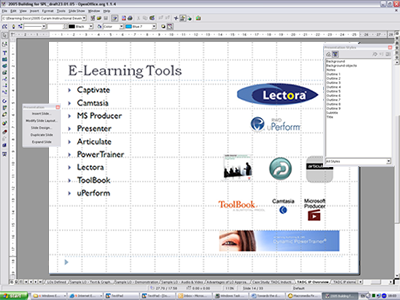
OpenOffice.org UI

Figure 1. PPT format presentation authored in OpenOffice.org

The primary benefit of OpenOffice.org for this open environment is the ability to author XML-based content to develop presentations that may be used in instructor-led classroom environments, as well as provide media developers with a PowerPoint-formatted file to facilitate insertion into the media authoring tool Microsoft Producer 2.

In my view, the real power of OpenOffice.org is that it enables courseware developers to take (for example) PowerPoint presentations developed by SMEs, modify this content, and output it in an XML-based format, allowing integration with the other tools we are discussing in this series.

In a sense, it is a "bridge": despite the much-vaunted interoperability of Microsoft XML Core Services (MSXML) in Office 2007, I would assert that there are still many issues associated with integrating MS Office-produced content into an open environment, and by extension problems using this suite if you need to integrate your content into another environment or platform.

__________

References:

OpenOffice.org version 3.x. [Internet] Available from: http://www.openoffice.org [Accessed 24 August 2009]

--

Thursday, October 8, 2009

Open Source E-learning Development 2: Image Manipulation

First today, a preamble, in which I shall use the word “beauty.”

I’ve had some queries about my forthcoming article, wherein I will revisit themes I addressed in my 2008 post Recession and the challenge to e-learning. I’m still researching this topic: there are many sources to reference and data to be interpreted – and of course, the socio-economic landscape is still changing apace.

I am also re-reading Joseph Conrad’s Typhoon, a short story about the travails of Captain McWhirr and the steamer Nan-Shan, as I attempt to find a suitable context for the piece. You don’t know Conrad’s work, you say? of course you do; Francis Ford Coppola’s Vietnam epic Apocalypse Now was based on Conrad’s novel Heart of Darkness.

I’m not going to discuss this further here, except to express how extraordinary I think it is that a Polish man who did not speak English fluently until he was in his twenties became one of the 20th Century’s master prose stylists and novelist in English - which was essentially his second language - while most of us native speakers incompetently attempt to turn words into something meaningful, with utility, if not beauty.

Now read on…

The second open environment authoring tool highlighted in this series is an image editing application.image

The GNU Image Manipulation Program, or GIMP, is an open source graphics editor that is available for Linux, Windows, and OS X. It is a freely-distributed raster graphics editor used to process digital graphics and photographs. GIMP is primarily used for photo manipulation, including sizing, editing, and cropping images, combining multiple images, and converting between different image formats. GIMP can also be used to create basic animated GIFs.

According to GIMP.org,

[GIMP] has many capabilities. It can be used as a simple paint program, an expert quality photo retouching program, an online batch processing system, a mass production image renderer, an image format converter, etc.

GIMP is expandable and extensible. It is designed to be augmented with plug-ins and extensions to do just about anything. The advanced scripting interface allows everything from the simplest task to the most complex image manipulation procedures to be easily scripted.

Typical uses include:

  • creating graphics and logos
  • resizing and cropping photos
  • color management
  • combining multiple images
  • removing unwanted image features
  • converting between different image formats

GIMP can also be used to create simple animated GIF images. It is often used as a “software replacement” (Paul, 2008) for Adobe Photoshop.

The application has read/write support for popular image formats such as BMP, JPEG, PNG, GIF and TIFF, as well as the proprietary file formats of several other applications such as Autodesk *.flic animations, Paintshop Pro images and Adobe Photoshop Documents. Other formats with read/write support include PostScript documents. GIMP can also read and write path information from SVG files. GIMP can also read/write ICO Windows icon files. Its native format is XCF.

Figure 1. A screenshot of the GIMP UI

GIMP can also import Adobe PDF documents and the raw image formats used by many digital cameras. However, it can’t save to these formats; rather files must be exported to one of the image file types it does support.

__________

References:

GNU Image Manipulation Program Home Page: http://www.gimp.org/

Paul, R. (2008). GIMP 2.6 released, one step closer to taking on Photoshop. Ars Technica. [Internet] Available from: http://arstechnica.com/open-source/news/2008/10/gimp-2-6-released-one-step-closer-to-taking-on-photoshop.ars. Accessed 2nd July 2009.

--

Tuesday, October 6, 2009

A Toolkit to Develop E-Learning in an Open (XML) Environment

Returning from content development theory, the gratis/libre debate, and the pros and cons of each approach, this post will focus on the range Opensource.svg of tools that you need to develop e-learning content in a (relatively) open environment.

Now read on…

The key to developing e-learning courseware in an open environment is to use a production model that liberates instructional design and content authoring from your final media outputs. In my view, this means taking an XML-based approach to your e-learning development environment. I would suggest that you need tools and components like the following tools to create an effective authoring and delivering system:

Content Creation Tools

  • DocBook
  • XMLmind XML Editor (XXE)
  • GNU Image Manipulation Program (GIMP)
  • XSLT transformations and XS-FOP formatting object processors


Media Creation and Integration: OSS Tools

  • Audacity
  • CineFX
  • Kompozer
  • OpenOffice.org
  • GNU Image Manipulation Program (GIMP)

Media Creation and Integration: Free-to-use Proprietary Tools
  • Microsoft Producer 2
  • Windows Media Developer’s Kit
  • Garageband
  • iMovie
  • Jing

Content Delivery Platform
  • Apache / MySQL / PHP
  • Moodle
  • Joomla
  • Drupal

Optional Proprietary Tools
  • Adobe Flash
  • Camtasia
  • Roxio Easy Media Creator or Toast

I'll be discussing developing a production model using this toolkit, starting tomorrow.
--

Monday, October 5, 2009

E-Learning, the Cathedral and the Bazaar: Courseware Development Approaches

...or Top-down versus Bottom-up approaches to content design.

In his 1997 essay The Cathedral and the Bazaar, open source evangelist Eric S. Raymond suggests that

the closed-source world cannot win an evolutionary arms race with open-source communities that can put orders of magnitude more skilled time into a problem.
Raymond considers the development of software by traditional methodologies as analogous to building a mediaeval cathedral,
carefully crafted by individual wizards or small bands of mages working in splendid isolation, with no beta to be released before its time.
He asserts that all software could be developed using the bazaar approach, which he described as
a great babbling bazaar of differing agendas and approaches... open to the point of promiscuity.

In this so-called Bazaar Model, roles are not clearly defined. Gregorio Robles suggests that software developed using the Bazaar model should exhibit the following patterns:

  • Users should be treated as co-developers
The users are treated like co-developers and so they should have access to the source code of the software. Furthermore users are encouraged to submit additions to the software, code fixes for the software, bug reports, documentation etc. Having more co-developers increases the rate at which the software evolves. Linus' Law states that, "Given enough eyeballs all bugs are shallow." This means that if many users view the source code they will eventually find all bugs and suggest how to fix them. Note that some users have advanced programming skills, and furthermore, each user's machine provides an additional testing environment. This new testing environment offers that ability to find and fix a new bug.
  • Early Releases
The first version of the software should be released as early as possible so as to increase one's chances of finding co-developers early.
Frequent Integration
New code should be integrated as often as possible so as to avoid the overhead of fixing a large number of bugs at the end of the project life cycle. Some open source projects have nightly builds where integration is done automatically on a daily basis.
  • Several Versions
There should be at least two versions of the software. There should be a buggier version with more features and a more stable version with fewer features. The buggy version (also called the development version) is for users who want the immediate use of the latest features, and are willing to accept the risk of using code that is not yet thoroughly tested. The users can then act as co-developers, reporting bugs and providing bug fixes. The stable version offers the users fewer bugs and fewer features.
  • High Modularization
The general structure of the software should be modular allowing for parallel development.
  • Dynamic decision making structure

There is a need for a decision making structure, whether formal or informal, that makes strategic decisions depending on changing user requirements and other factors (i.e. in extreme programming).

In Raymond's view, most well-known OSS products including Linux, Apache, and the GNU Compiler Collection align with the Bazaar model.
In the 'traditional' Cathedral model (advocated in Fredrick P. Brooks, Jr. in The Mythical Man-Month), development takes place in a centralized fashion. Clearly defined roles including experts dedicated to designing (the architects), established management styles, and 'craftsmen' (developers) responsible for implementation all contribute build a pre-established design according to a pre-agreed blueprint.


He goes further to say that in order to preserve the architectural integrity of a system, its design should be done by as few architects as possible.

Interestingly, the Bazaar model comes close (in manifestation, if not in philosophy) to what Brooks in the 1995 Anniversary edition of his text describes as "shrink-wrapped software." Brooks suggests:

For the developer in the shrink-wrapped industry, the economics are entirely different from those of the classical industry... the starkly different economies have given rise to starkly different programming cultures.

(p.284)


Rather than the traditional Cathedral model,
The shrink-wrapped industry... [is] freewheeling and fiercely focused on getting the job done rather than on process. in this climate, there has always been a much greater recognition of the talent of the individual programmer, an implicit awareness that great designs come from great designers [my italics]. The start-up culture has the capability of rewarding star performers in proportion to their contributions... [i]t is not surprising that many of the stars of the new generation have gravitated to the shrink-wrapped industry.

(p.284)


More tomorrow as I discuss towards the implications of these two models for the e-learning industry.

___________
References:

Brooks, R.P. (1995). The Mythical Man-Month Anniversary Edition London, Addison Wesley Longman, Inc.


Raymond, E. S. (2000). The Cathedral and the Bazaar Version 3, Revision 1.57 [Internet] Available from: http://www.catb.org/~esr/writings/
cathedral-bazaar/cathedral-bazaar/
[Accessed 22nd August 2009]

Robles, G. (2004) A Software Engineering approach to Libre Software, IN: Robert A. Gehring, Bernd Lutterbeck: Open Source Jahrbuch 2004, Berlin: Lehmanns Media. [Internet] Available from: http://www.opensourcejahrbuch.de/download/
jb2004/chapter_03/III-3-Robles.pdf
[Accessed 21st April 2008]
--

Friday, October 2, 2009

An Open Source Environment for E-Learning Content Development

As I'm in the process of updating my website’s Learning Content Management System (LCMS), I though it would be interesting to discuss open source environments, and how they Opensource.svgcan be implemented in an e-learning content development ecosystem.

Context

When I began developing my website and blog, I decided to use an open standards approach during the course of their initial development, as much for philosophical as for financial or any other reasons. Consequently, as I implement new features (such as my podcasts), and maintain and enhance site functionality, I adhere to the approach, principles and methodologies of the Open Source movement in as far as is practicable.

Now read on...

In as much as is possible, I try to develop content using non-proprietary tools, usually freely available under the GNU Licence. Examples of this type of software include:

  • Audacity - an audio editor
  • Freemind - a mind mapping tool
  • OpenOffice.org - an office application suite for a range of operating systems including Windows and Linux
  • NeoOffice - A port of OpenOffice.org to the MacOS X platform.
  • Apache - a Web server.
  • PHP – a scripting language.
  • MySQL - database software.

The Gratis versus Libre Debate

It is important to define usage of the word “open” in the term “open environment:” in this context, I qualify the use of "open" as adhering to the openformats.org definition:

We will say that a file format is open if the mode of presentation of its data is transparent and/or its specification is publicly available. Open formats are ordinarily standards fixed by public authorities or international institutions whose aim is to establish norms for software interoperability. There are nevertheless cases of open formats promoted by software companies which choose to make the specification of the formats used by their products publicly available.


It should be noted that an open format can either be coded in a transparent way (readable in any text editor: this is the case of markup languages) or in a binary mode (unreadable in a text editor but thoroughly decodable once the format specifications are known) .

I should note that while most of the tools I will discuss in this series of articles are ‘true’ open source applications - freely distributable (“free as in speech”), some (like Microsoft Movie Maker) are free from cost - “in the sense that one does not have to pay for some good or service. ” (Wikipedia.org).


My view is that both categories of software enable me to meet my objective of developing courseware, and being of a practical bent, I don't really suffer an ethical dilemma in combining a range of tools if they assist me in achieving my goals. However, I think that it is important to discuss the implications of open software, particularly as the debate is central to the notion of specifications and standards, and how they are implemented. I haven't discussed learning standards yet in my blog, but it is a topic I will be talking about at a later time; I think that elements of this discussion reflect directly on SCORM, AICC, QTI and other learning-related specifications and standards.

What is "free" software?

Free software is a matter of the users' freedom to run, copy, distribute, study, change and improve the software. More precisely, it refers to four kinds of freedom, for the users of the software:

  • The freedom to run the program, for any purpose (Freedom 0).
  • The freedom to study how the program works, and adapt it to your needs (Freedom 1). Access to the source code is a precondition for this.
  • The freedom to redistribute copies so you can help your neighbor (Freedom 2).
  • The freedom to improve the program, and release your improvements to the public, so that the whole community benefits (Freedom 3). Access to the source code is a precondition for this.

A program is free software if users have all of these freedoms. Thus, you should be free to redistribute copies, either with or without modifications, either gratis or charging a fee for distribution, to anyone anywhere. Being free to do these things means (among other things) that you do not have to ask or pay for permission.

(GNU.org)

So, how can we reconcile using free-from-cost software (which usually comes with the kinds of restrictions associated with commercial organizations' End User License Agreements) with this manifesto?

More...
--

Tuesday, April 7, 2009

Adobe eLearning Suite Review on BDLD

Donald Clark has very comprehensively reviewed the new Adobe eLearning Suite (eLS) on his always interesting and informative Big Dog, Little Dog blog.

As you may recall, I posted on eLS when the suite was released, and while welcoming this addition the e-learning practitioners’ content development toolkit, I tempered my enthusiasm as follows:

Where I think Adobe missed a trick is that they should have released this package at least five years ago. While we can say that in the early 2000’s, the e-learning industry wasn’t as large a market segment as it is today, it was eLS_boxsubstantial enough. Certainly enough of a market segment to be a valuable revenue-generating stream for the company. Unlike DTP, graphical design, and video post-production (which were digitized evolutions of existing industries) e-learning was a whole new industry, a real-life child of the World Wide Web.

I’ll give with one hand and take away with the other: well done Adobe, great to see you’ve finally committed to e-learning; equally, an e-learning suite of tools is such an obvious addition to your product range that you should have done this years ago.

The suite consists of the following apps:

Tool Adobe's Description
Captivate mnemonic Adobe Captivate® 4

Create and deliver rich interactive content

Dreamweaver mnemonic

Adobe Dreamweaver® CS4 with CourseBuilder Extension

Design, develop, and maintain standards-based websites and applications

Flash mnemonic

Adobe Flash® CS4 Professional with Learning Interactions

Create and deliver rich interactive content

Photoshop mnemonic

Adobe Photoshop® CS4 Extended

Discover new dimensions in digital imaging

Presenter mnemonic

Adobe Presenter 7

Rapidly create high-impact Adobe Flash presentations and eLearning courses from PowerPoint

Soundbooth mnemonic

Adobe Soundbooth® CS4

Create and edit audio with ease
acro9logo

Adobe Acrobat® 9 Pro

Protect documents and accelerate information exchange with PDF

Very full-featured indeed: if I was starting work today as a learning and development professional and I was handed this set of applications as my courseware production platform, I would be very happy with it.

But don’t just take my word for it: here’s (a very highly abridged version of) what Donald Clark has to say:

It is a complete and tightly integrated solution for authoring rich learning content. …All-in-all the Adobe eLearning suite is a great product for designers, being that it is the first elearning suite.

His review describes the applications and functionality of the Suite in very good detail, and Donald uses his own experience of using the platform to throw further light on how the applications integrate to enable e-learning designers (“instructional designers, developers, and other learning specialists”) to create high-quality courseware.

Donald concludes his article by discussing what he’d like to see in version next of the Suite and his overall impression of the package. Click here to read the review in full.

Note: Adobe have published and are maintaining a useful blog for Captivate users. Click here for more.

--

Friday, January 23, 2009

Adobe (finally) release eLearning Suite

We’ve all been using Adobe products for years. Even the most non-techie “I-can’t-find-the-Any-key” computer user almost certainly has the Flash Player installed in their browser; if you’re an learning professional of my vintage (30’s) you’ve probably encountered Authorware, Director, and Flash at some point in your career. More recently (as discussed on The E-Learning Curve Blog last week) Adobe have contributed significantly to the adoption of Rapid E-Learning through the ongoing development of easy-to-use tools like Captivate (currently on version 4) to enable learning and development pros create content without having to be a competent or proficient coder or media expert.

Finally, Adobe have recognized that like graphics, DTP, and digital / video media production, e-learning is a significant market vertical for their applications, and have released the Adobe eLearning Suite (eLS). According to their website, eLearning Suite

…software integrates best-of-breed tools for rapid eLearning, courseware authoring, simulations, and media editing. Create rich, imageinteractive learning experiences that engage audiences with video, audio, and powerful visuals. Work productively with rapid authoring tools that deliver smart collaboration features as well as tight integration with asset-creation tools. And deliver content to the web, the desktop, mobile devices, and Learning Management Systems.

The suite consists of the following apps:


Tool Adobe's Description
Captivate mnemonic Adobe Captivate® 4

Create and deliver rich interactive content

Dreamweaver mnemonic

Adobe Dreamweaver® CS4 with CourseBuilder Extension

Design, develop, and maintain standards-based websites and applications

Flash mnemonic

Adobe Flash® CS4 Professional with Learning Interactions

Create and deliver rich interactive content

Photoshop mnemonic

Adobe Photoshop® CS4 Extended

Discover new dimensions in digital imaging

Presenter mnemonic

Adobe Presenter 7

Rapidly create high-impact Adobe Flash presentations and eLearning courses from PowerPoint

Soundbooth mnemonic

Adobe Soundbooth® CS4

Create and edit audio with ease
image

Adobe Acrobat® 9 Pro

Protect documents and accelerate information exchange with PDF

Quite impressive – if I was starting work today and I was handed this set of applications as my content development toolkit, I would be very happy indeed. Similarly, as you can see from Figure 1 (below) the Suite’s workflow plays to the strengths of the individual applications. I would assert that this workflow is industry-standard practice, as already implemented by most e-learning developers worth their fee, so no surprises there.

els_workflow

Figure 1. eLS workflow

However, where I think Adobe missed a trick is that they should have released this (or a similar) package at least five years ago. While we can say that in the early 2000’s , the e-learning industry wasn’t as large a market segment as it is today, it was substantial enough. Certainly enough of a market segment to be a valuable revenue-generating stream for the company. Unlike DTP, graphical design, and video post-production (which were digitized evolutions of existing industries) e-learning was a whole new industry, a real-life child of the World Wide Web.

Think of the opportunity they had to build a loyal and growing customer- and user base if they had released this suite in 2002, and you’ll realize what they let slip through their corporate fingers. As it stands, learning professionals in the past had to build their own toolkits: at this stage I’m not going to change from SoundForge to Soundbooth, for example, or from DocBookXML and XXE to Acrobat Pro - but I will of course keep using Captivate, Flash and Dreamweaver.

So I’ll give with one hand and take away with the other: well done Adobe, great to see you’ve finally committed to e-learning; equally, an e-learning suite of tools is such an obvious addition to your product range that you should have done this years ago.

--

Wednesday, September 17, 2008

Open source e-learning courseware development - Salasaga update

As I've discussed in the past, there's a whole constituency of e-learning courseware developers who, for either practical, philosophical, or even purely financial reasons have decided to create learningsalasaga_linux-0.8.0-alpha1 content using open source and free-to-use courseware.

One of the tools I looked at in the past is an open source Integrated Development Environment for producing e-learning called Salasaga. According to the author it will be

a free, easy to use GUI authoring environment that helps you create visually impressive and actually useful learning material. The short term goal for this project is to provide such an environment, and we're well on the way to a first release for doing that.
Initially similar to Adobe Captivate, but will eventually incorporate an AJAX (browser based) playback capability for advanced content. Flash has at least one serious design limitation (from [his] POV) making it nearly useless for comprehensive e-learning, and this appears to be addressed by the existing capabilities of AJAX in browsers these days.

Today, I just received an e-mail from Justin Clift, the developer behind the IDE. He updated me on the latest developments with the tool; primarily that it's in Alpha 4 version at the moment, and that going to included in Ubuntu Intrepid. He's excited.

In my view, any tool or utility that enables a wider range of people to access e-learning, whether as learners, or as in this case through leveraging the means of production can only help the future growth of e-learning as a means of educating the widest possible group of people.

--

Tuesday, May 6, 2008

Open Environment E-learning 6: Microsoft Producer

Microsoft Producer for Microsoft Office PowerPoint 2003, the current version of this popular add-on for Microsoft PowerPoint, is a freely available application that facilitates the capture, synchronisation, and publishing of audio, video, slides, and images. The primary reasons for choosing this application for content integration were it’s low learning curve for non-media experts, as well as it’s facility to export SCORM metadata as part of the final output package.

Other features include the familiar Microsoft Office interface provided, as well as the ability to import Microsoft formats including Visio files, Windows Video and Windows Audio files, spreadsheets data etc., without major conversion issues. These file formats are output as common HTML, JPEG and GIF files during rendering, and appropriate structured metadata is generated to mark the content for inclusion in a database repository.

Some disadvantages of Microsoft Producer are that it will not “play well” with file formats like QuickTime .MOV files, Photoshop .PSD files or Adobe .PDF documents, which means that content needs to be rendered in a Microsoft-friendly format.

Microsoft Producer enables the content integrator, in a three-tabbed timeline-based interface, to finely-tune synchronisation of the slide, audio, and video elements of the presentation.

(Using Microsoft Producer: A Guide for Educators, pp. 6-7)


msprod2

Figure 1 Microsoft Producer 2 UI

Final rendering of content was normalised using bit-rate, hardware and software parameters optimised for output to DVD for playback on Windows-based PCs and laptops.


References:

Microsoft Corporation Inc. (2004) Using Microsoft Producer: A Guide for Educators [Internet] Available from: http://www.microsoft.com/education/edguideproducer.mspx Accessed 4 Apr 2008 pp6-7

--

Friday, May 2, 2008

Open Environment E-learning 5: Audacity Audio Editor

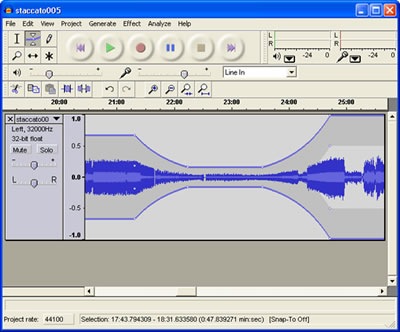
Having discussed a range of primary design and authoring tools, today's post will look at one of the key content development tools, an open source non-linear audio editor (NLE) called Audacity.

[It] is an easy-to-use audio recorder and editor for Windows, Mac OS X, GNU/Linux, and other operating systems .

(sourceforge.net)

Audacity has the capability to record live sound, convert analogue media sources, and manipulate audio. Its functions include:

  • Export to digital recordings like podcasts or CDs
  • Edit WAV, MP3, FLAC, and Ogg Vorbis sound files
  • Cut, copy, splice, and mix multiple audio files
  • Apply a range of digital signal processes including normalization, noise reduction, EQ, and compression

audacity audio editor

Figure 1 Audacity audio NLE

Audacity enables audio content may be exported in a wide range of formats, making it an exceptionally flexible tool for content developers. With a relatively shallow learning curve, the application can be used by non-experts after a few hours on instruction and use, while retaining the features found in proprietary NLEs like Steinberg WaveLab and Sony Sound Forge for media developers .

This level of functionality enables both SME and specialist content developers to take advantage of the features in the application in an Open Environment for E-Learning.

References:


Audacity website About Audacity [Internet] Available from: http://audacity.sourceforge.net/about Accessed 1 May 2008

--

Thursday, May 1, 2008

Open Environment E-learning 4: Mind Mapping Tools

Designing the structure of a syllabus, curriculum, or course is one of the key activities to be undertaken well to ensure the course meets the learners' needs. A discussion about approaches to instructional design is beyond the remit of this series of posts on developing learning content in an Open Environment; I recommend Benjamin Bloom's Taxonomy of Educational Objectives as a good starting place to investigate this broad discipline.

Now read on...

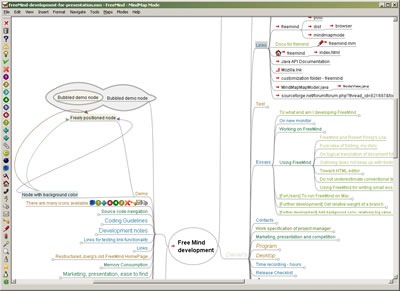
Instructional designers use a range of tools to develop the instructional design (ISD) of e-learning courseware, everything from pen-and-paper to word processors to more specialized ISD tools like mind mapping applications: one of the most effective of this latter category is Freemind.

A mind map is a diagram used to represent words, ideas, tasks or other items linked to and arranged radially around a central key word or idea such as a learning objective. It is used to generate, visualize, structure and classify ideas, and as an aid in organizing content.

Mind map in Freemind

Figure 1 A mind map in the Freemind UI

FreeMind is an open source mind mapping application written in Java.

It supports the following features:

  • Folding of branches
  • Export to XML, HTML, XHTML (a static 'all-expanded image' plus expanding +/- list below image). Also exports an 'all-expanded image' in the following formats: PNG, JPEG, SVG and PDF format. Images are non-interactive. The current Beta version; v.0.9.0 Beta 8 supports export to Flash SWF).
  • Icons on nodes
  • Clouds around branches
  • Graphical links connecting nodes
  • Search restricted to single branches
  • Web and file hyperlinks from nodes

More tomorrow.

--

References:

Bloom B. S. (1956). Taxonomy of Educational Objectives, Handbook I: The Cognitive Domain. New York: David McKay Co Inc.

Links:

Freemind website on SourceForge.net [Internet] http://freemind.sourceforge.net/wiki/index.php/Main_Page (Accessed 30 April 2008)