The E-Learning Curve Blog has moved!

You will be automatically redirected to the new address in 10 seconds. If that does not occur for some reason, visit
http://michaelhanley.ie/elearningcurve/
and update your bookmarks.

Showing posts with label e-learning toolkit. Show all posts

Friday, October 9, 2009

Open Source E-Learning Development 3: Open Office.org

Having discussed two key components of this Open Environment for E-learning; an XML-based authoring and content-generation tool, and an image-manipulation application, today I will discuss an XML-based productivity suite - a word processor, spreadsheet application, and presentation tool called OpenOffice.org.

In my view, tools like DocBook XML and XMLmind XML Editor are excellent primary content creation and generation applications; they provide imagecourseware developers with a familiar UI in which to create their content, while retaining the flexibility and interoperability of an XML-based structure.

One of the main benefits of using XML-based tools (as we will see in a future post) is that it facilitates a "create once, reuse many times" approach to content objects. By creating one appropriately-tagged XML-based master document, content can be refactored as a printable manual, an HTML-based guide, a PowerPoint-type presentation, and integrated into an e-learning content delivery platform, all based on one set of source XML-based information.

Now read on...

It is a truism that instructional designers, courseware developers and learning professionals (particularly in organizations) will source knowledge and learning materials from subject matter experts (SMEs) if possible. This research can be undertaken by using a range of strategies, including searching corporate knowledge-bases, interviewing SMEs, task-based collaboration, and so on.

While SMEs have the tacit and explicit knowledge, skills and domain expertise to inform your instructional design and content requirements, typically they have neither the time nor the inclination to learn a quite complex application like DocBook XML or XXE. However, we can say that the substantial majority of knowledge workers are competent in office productivity programs including word processors, spreadsheet, and presentation applications, such as those included in the Microsoft Office suite.

Sun’s OpenOffice.org is a collection of applications that provide the features expected from a modern office suite. These components are designed to reflect the functionality available in Microsoft Office.

According to their mission statement, the OpenOffice.org project aims

…to create, as a community, the leading international office suite that will run on all major platforms and provide access to all functionality and data through open-component based APIs and an XML-based file format.
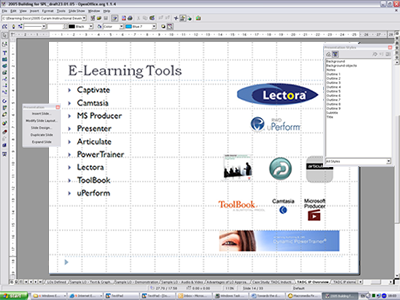
OpenOffice.org UI

Figure 1. PPT format presentation authored in OpenOffice.org

The primary benefit of OpenOffice.org for this open environment is the ability to author XML-based content to develop presentations that may be used in instructor-led classroom environments, as well as provide media developers with a PowerPoint-formatted file to facilitate insertion into the media authoring tool Microsoft Producer 2.

In my view, the real power of OpenOffice.org is that it enables courseware developers to take (for example) PowerPoint presentations developed by SMEs, modify this content, and output it in an XML-based format, allowing integration with the other tools we are discussing in this series.

In a sense, it is a "bridge": despite the much-vaunted interoperability of Microsoft XML Core Services (MSXML) in Office 2007, I would assert that there are still many issues associated with integrating MS Office-produced content into an open environment, and by extension problems using this suite if you need to integrate your content into another environment or platform.

__________

References:

OpenOffice.org version 3.x. [Internet] Available from: http://www.openoffice.org [Accessed 24 August 2009]

--

Monday, February 9, 2009

Capture that E-Learning Demo: Update

I’ve been getting some very positive feedback about my recent series of blog posts reviewing TechSmith Camtasia and Adobe Captivate. Some contributors have also been kind enough to point out some deficiencies regarding the usability of the review - you may recall it was written over four days and four posts. One great suggestion was to create a TOC in each post so that readers could easily navigate to each section of the review.

Given the number of responses to the E-Learning Demo comparison articles, I have decided to combine them and make them available to all as a downloadable whitepaper (PDF format) so that capcampdfthe review can be read in one easily-accessible document.

Click here read the review in a new browser window, or right-click and Save As… to download a copy of the paper to your PC or Mac. You will need Adobe Reader to view the file. Click here to download Adobe Reader 9.

My final thought for today: I put a lot of time and effort into writing (hopefully) useful, informative and stimulating material for this e-learning blog. Being a learning and development professional, the posts I find most satisfying to write concern the reasons people want to learn, the theories and approaches that support learning, and how best to enable learners to acquire knowledge. I guess I have to admit that sometimes I forget that maybe the practical ‘just-in-time’ material is as important as the more esoteric material. In future, I’ll certainly add more posts concerning the practical elements of e-learning development, deployment and delivery into the mix.

--

Monday, January 12, 2009

Capture that E-learning Demo 4: Captivate and Camtasia, concluded

Continuing my evaluation of Captivate and Camtasia Studio...

In my previous posting, I discussed the two applications' user interfaces and audio capabilities. Today, I will look at workflow and usability.

Captivate Usability

Captivate offers three customizable capture presets - demonstrations, assessment simulations, and training simulations. If you choose an assessment simulation, Captivate won’t capture mouse movements that highlight boxes, or text captions that would tell the learner how to proceed in the assessment. In demonstration mode, Captivate doesn’t include Click boxes, since it assumes that the audience is passively viewing the content.

As mentioned last time, Captivate uses an object-orientated paradigm to develop content. As such, events and interactions are captured as a series of screens. In edit mode, the content author can flexibly create new screens, import content (in a number of formats including AVI, PPT, and FLV), change the sequence of events, and delete unused content. As you can see from Figure 1, the edit tab look-and-feel is a combination of the Macromedia / Adobe Unified User Interface and Microsoft PowerPoint: this indicates to me that Adobe are targeting users familiar with developing content in the latter program as their core market for Captivate.

cap2Aud

Figure 1. Detailed view of the Captivate UI.

[Click here to view larger image]

In this context, the UI works very well indeed; you can actually create a PowerPoint presentation in it's native format, import it to Captivate, enhance it with motion-based media, animations, quizzes, and audio narration, and generate a learning object with ease. The inclusion of a timeline at the center-top of the UI is reminiscent of Flash and Director, so users familiar with these authoring tools can transition to Captivate-based content creation. The timeline also contains the vector-based mouse layer, which enables the modification of the mouse motion track in a demo or slide,

Compared to Camtasia, Captivate captures a broader range of text and interactive elements. The author can also add Text Entry boxes, clickable buttons, animations and text animations. Once an element is added to the timeline, it can be lengthened, reduced, and repositioned, which allows for a high level of precision - count on spending plenty of time tweaking the automatically captured elements to get the timing right.

Camtasia's Usability

If you've ever used Windows Movie Maker, you will be familiar with the Camtasia Studio UI. The interface is based on the video editing suite paradigm and includes all the common features of this editing environment - a preview window, a timeline where edits are made, a clip bin, and effects (cross fade, contrast/brightness etc) controls. Since Camtasia captures all mouse and screen events, it’s perfect for developing process flows, hot to's and application demonstrations. Camtasia does not automatically generate onscreen text media like callouts, but they can be added manually in post-production. As with Captivate, TechSmith's program allows for very precise location of callouts and highlights. Similarly Flash Hot Spots—callouts with additional Flash properties— can be included - though you have to render the entire project to view their operation, which is a nuisance (Captivate facilitates a single frame, five frame, or entire movie preview which is great for testing interactive functionality). It is possible to add quizzes in Camtasia, but the results are not scored as they are in Captivate.

Conclusions
And so this is where I came in: I still don't know which application I prefer. Used together as part of your e-learning content development toolkit, the applications will provide you with the ability to cover most (if not all) e-learning development eventualities. Because of my own professional background in digital media development, I feel more at home using Camtasia, but that does not mean that it's better at what it does. In terms of Camtasia's advantages I could highlight the better digital media manipulation, sophisticated features like zoom-and-pan, and wider range of output formats that Captivate just can't match. On the other hand, Captivate is much more capable and easier to use when creating assessments and simulations, especially with its ability to preview Click Boxes and other user input in Preview mode.

A comment contributor to the E-Learning Curve Blog called rjnagle was kind enough to share their experience of the apps with me:

Captivate has lots of quirks that take getting used to. I haven't used the elearning capabilities, only the demo capabilities.

First, the html output consists of several swf files, several of whom reference the other. It can be troublesome to put on a website.

Some basic editing features end up taking a lot of time. (for example, I've never figured out how to crop the beginning of an animation, only the end). I notice that sometimes when you impose text it will append dead time at the end.

I wish there were a way to speed up the animation time so that it plays more rapidly.

Also, despite the claims of the documentation, you simply can't attach more than one slide to an audio clip. It causes lots of problems.

I do like the fact you can import slides from other projects into the current one.
-

They go on:

I have been disillusioned about Captivate, but once I recognize what it does well, I can manage.

The problem is that on the job you typically are able to choose one or the other, not both.

As I said when I began this series, each program has uniquely excellent functionality.

In the context of my contributor rjnagle, I would have to suggest that if your requirements center on demo development (and not e-learning), Camtasia Studio is the better tool. As for me? Well... I would assert that (for the moment) both tools are essential. Once you become familiar with their strengths, weaknesses, and quirks, it is hard to imagine working without either one.

____________

Find Out More:

Adobe Captivate Homepage

TechSmith Camtasia Studio Homepage

--

Friday, January 9, 2009

Capture that E-learning Demo 3: Captivate and Camtasia

In the previous two blog posts, I outlined – at a very high level - some of the features and functionality of TechSmith Camtasia Studio and Adobe Captivate, and in today’s post I will provide a equally high level assessment of these products, not so much in comparison to each other, but rather more at tools that enable learning professionals to create immersive, media-rich demonstrations and learning objects.

Now read on…

Writing this review has proven to be a much more difficult (and time-consuming) task that I had anticipated it would be; in fact, I can say that I experience a mild cognitive dissonance whenever I’m asked the question “which do you prefer (or recommend): Camtasia or Captivate?”

The answer is I don’t know. Or more accurately, I still don’t know. More on this later. Like most people (in any industry) I tend to have a single ‘weapon of choice’ for each task I undertake. Last weekend I spent some time doing some DIY around the house for example, and despite owning many screwdrivers, I always return to my trusty old Stanley DynaGrip 10, Stanley_Screwdriver pretty much regardless of the gluing and screwing job I’m doing. Similarly when I post-produce video I use one editor – Vegas Video, when I edit audio the files are authored in SoundForge, and I use DreamWeaver to do 95% of my HTML and website- related production. But when it comes to authoring demos? Well… there I have a problem. Inevitably I run mentally run through the dialog that I am about to share with you, dear reader.

Adobe Captivate and TechSmith Camtasia Studio are similar e-learning content development tools with uniquely different strong points. If you’re creating a software demo, or a PowerPoint presentation to deliver online, Camtasia is a better application; conversely, if you’re making interactive web-based training, or a complex software demonstration, Captivate is superior is definitely the tool for the task.

Even where their functionality converges, their operating procedures and user interface are so different that each will probably appeal to different users. If (like me) your background is in media production, you’ll find Camtasia easy to learn and use, and Captivate frustrating. On the other hand, if you’re used to authoring content in PowerPoint, you’ll find Camtasia a strange, and Captivate more intuitive and fit-for-purpose.

cap_cap

Figure 1. Captivate UI (above), Camtasia UI (below).

[Click image to enlarge]

Beyond these, however, are certain functions at which one product excels and the other either doesn’t perform or performs quite poorly. For example, Camtasia excels at capturing streaming video content, which Captivate cannot do. If you need to ‘pan and scan’ a close-up of a screen element of the content that you’ve captured, Camtasia is your only choice. However, the reverse pertains if you’re creating a quiz - Captivate offers a much richer toolset. Similarly Captivate’s ability to generate Word or PDF versions of files for hardcopy distribution is a fantastic timesaver.

Indeed, the more you use both tools, the more you begin to realize that if you’re authoring a range of e-learning, demonstration, and presentation projects, you probably really need both .

Using Camtasia
Like most screen-capture utilities, Camtasia captures a video of the screen as you interact with it, with added audio if you enable narration, as well as Picture-in-Picture (PIP) video if you add a webcam. The resultant CAMREC output file is a recording of all of the audio, video and interaction elements. In editing mode, Camtasia enables the addition of multiple tracks for captions, breakout boxes, callouts, PIP, quizzes, and so on.

Using Captivate
Captivate works differently. Rather than capturing one multiplexed file, Captivate captures the user’s interactions as a series of screens, each containing one mouse click and movement. Very much like its progenitor Flash, Captivate stores each object of each captured screen as a separate element. As with Camtasia, you may add additional content enhancements – 508-compliant closed captioning, callouts, quizzes, etc in post-production.

Audio
Both applications enable the author to either record audio narration in real time during capture time, or import MP3 or WAV audio in post-production. In my experience, Captivate audio recorded in real time loses synchronization over the duration of the recording: this becomes especially noticeable in 20-minute-plus recordings and can be very frustrating to remediate. However you can add post-content captured audio slide by slide (tedious), or by importing a completed audio file. A very neat feature of Captivate is that it recognizes audio markers, so if you include these in your WAV or MP3 file, it will synchronize with the slides in the presentation. I have also noticed that the audio generated by Captivate can be pretty ropey (even though it’s MP3 format) – in fact, at some of the lower sample- and bit rates, it reminds me of the horrible .VOX format I had to use in my Authorware days, back in the last century.

In my view, Camtasia Studio provides a much more easy-to-use and intuitive audio recording and editing experience. The fact that you can see all the audio on a timeline layer means that you can see how the audio fits in context with the presentation's ‘big picture.’ The ability to split audio and move it around the timeline is an added bonus. Similarly, I feel that the audio enhancement features – normalization, noise reduction (NR) and so on – are easier to preview and use in Camtasia. In terms of outputs, there no end to your choice of formats – MP3, WAV, and WMA. The facility to render podcast-formatted audio is a very cool feature that Captivate just can’t compete with.

This concludes this part of my head-to-head review.

Next time: Video editing, content rendering, and my conclusions.

--

Tuesday, May 6, 2008

Open Environment E-learning 6: Microsoft Producer

Microsoft Producer for Microsoft Office PowerPoint 2003, the current version of this popular add-on for Microsoft PowerPoint, is a freely available application that facilitates the capture, synchronisation, and publishing of audio, video, slides, and images. The primary reasons for choosing this application for content integration were it’s low learning curve for non-media experts, as well as it’s facility to export SCORM metadata as part of the final output package.

Other features include the familiar Microsoft Office interface provided, as well as the ability to import Microsoft formats including Visio files, Windows Video and Windows Audio files, spreadsheets data etc., without major conversion issues. These file formats are output as common HTML, JPEG and GIF files during rendering, and appropriate structured metadata is generated to mark the content for inclusion in a database repository.

Some disadvantages of Microsoft Producer are that it will not “play well” with file formats like QuickTime .MOV files, Photoshop .PSD files or Adobe .PDF documents, which means that content needs to be rendered in a Microsoft-friendly format.

Microsoft Producer enables the content integrator, in a three-tabbed timeline-based interface, to finely-tune synchronisation of the slide, audio, and video elements of the presentation.

(Using Microsoft Producer: A Guide for Educators, pp. 6-7)


msprod2

Figure 1 Microsoft Producer 2 UI

Final rendering of content was normalised using bit-rate, hardware and software parameters optimised for output to DVD for playback on Windows-based PCs and laptops.


References:

Microsoft Corporation Inc. (2004) Using Microsoft Producer: A Guide for Educators [Internet] Available from: http://www.microsoft.com/education/edguideproducer.mspx Accessed 4 Apr 2008 pp6-7

--

Friday, May 2, 2008

Open Environment E-learning 5: Audacity Audio Editor

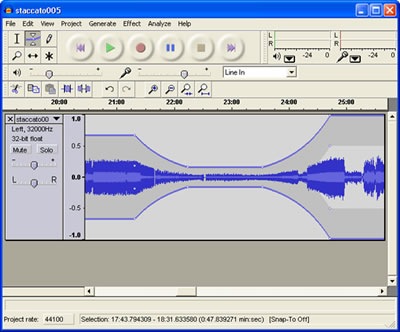
Having discussed a range of primary design and authoring tools, today's post will look at one of the key content development tools, an open source non-linear audio editor (NLE) called Audacity.

[It] is an easy-to-use audio recorder and editor for Windows, Mac OS X, GNU/Linux, and other operating systems .

(sourceforge.net)

Audacity has the capability to record live sound, convert analogue media sources, and manipulate audio. Its functions include:

  • Export to digital recordings like podcasts or CDs
  • Edit WAV, MP3, FLAC, and Ogg Vorbis sound files
  • Cut, copy, splice, and mix multiple audio files
  • Apply a range of digital signal processes including normalization, noise reduction, EQ, and compression

audacity audio editor

Figure 1 Audacity audio NLE

Audacity enables audio content may be exported in a wide range of formats, making it an exceptionally flexible tool for content developers. With a relatively shallow learning curve, the application can be used by non-experts after a few hours on instruction and use, while retaining the features found in proprietary NLEs like Steinberg WaveLab and Sony Sound Forge for media developers .

This level of functionality enables both SME and specialist content developers to take advantage of the features in the application in an Open Environment for E-Learning.

References:


Audacity website About Audacity [Internet] Available from: http://audacity.sourceforge.net/about Accessed 1 May 2008

--

Thursday, May 1, 2008

Open Environment E-learning 4: Mind Mapping Tools

Designing the structure of a syllabus, curriculum, or course is one of the key activities to be undertaken well to ensure the course meets the learners' needs. A discussion about approaches to instructional design is beyond the remit of this series of posts on developing learning content in an Open Environment; I recommend Benjamin Bloom's Taxonomy of Educational Objectives as a good starting place to investigate this broad discipline.

Now read on...

Instructional designers use a range of tools to develop the instructional design (ISD) of e-learning courseware, everything from pen-and-paper to word processors to more specialized ISD tools like mind mapping applications: one of the most effective of this latter category is Freemind.

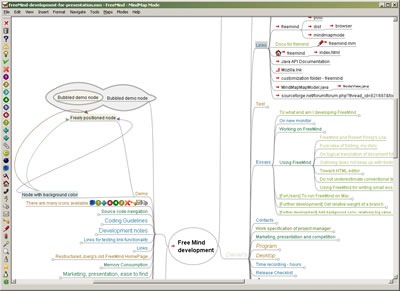
A mind map is a diagram used to represent words, ideas, tasks or other items linked to and arranged radially around a central key word or idea such as a learning objective. It is used to generate, visualize, structure and classify ideas, and as an aid in organizing content.

Mind map in Freemind

Figure 1 A mind map in the Freemind UI

FreeMind is an open source mind mapping application written in Java.

It supports the following features:

  • Folding of branches
  • Export to XML, HTML, XHTML (a static 'all-expanded image' plus expanding +/- list below image). Also exports an 'all-expanded image' in the following formats: PNG, JPEG, SVG and PDF format. Images are non-interactive. The current Beta version; v.0.9.0 Beta 8 supports export to Flash SWF).
  • Icons on nodes
  • Clouds around branches
  • Graphical links connecting nodes
  • Search restricted to single branches
  • Web and file hyperlinks from nodes

More tomorrow.

--

References:

Bloom B. S. (1956). Taxonomy of Educational Objectives, Handbook I: The Cognitive Domain. New York: David McKay Co Inc.

Links:

Freemind website on SourceForge.net [Internet] http://freemind.sourceforge.net/wiki/index.php/Main_Page (Accessed 30 April 2008)