The E-Learning Curve Blog has moved!

You will be automatically redirected to the new address in 10 seconds. If that does not occur for some reason, visit
http://michaelhanley.ie/elearningcurve/
and update your bookmarks.

Showing posts with label open e-learning environment. Show all posts

Monday, October 12, 2009

Open Source E-Learning 4: KompoZer Web Editor

E-learning is intimately bound to IT networks and to the World Wide Web. At their heart, many e-learning courses are just specialized websites, and most are created with some input from a website authoring tool. Website authoring tools are applications to build and link individual web pages to create a website.

Website authoring tools are not stand-alone applications; their purpose is to create design content to be distributed to learners via web servers. Website authoring tools are also reliant on media editors for the graphics, animations, audio, video and other media integrated into courseware.

Today's open source e-learning toolkit component is a website authoring tool called KompoZer.

KompoZer is a complete web authoring system that combines web file management and easy-to-use WYSIWYG web page editing capabilities found in Microsoft FrontPage, Adobe DreamWeaver and other high end programs. The application is designed to be extremely easy to use, making it ideal for non-specialist users who just want to create an attractive professional-looking website without needing to know HTML or web coding (see Figure 1).

imageFigure 1. KompoZer User Interface
[Click to Enlarge]

According to KompoZer's developers, the application supports:

  • WYSIWYG editing of pages, making web creation as easy as typing a letter with your word processor.
  • Integrated file management via FTP. Simply login to your website and navigate through your files, editing web pages on the fly, directly from your site.
  • Reliable HTML code creation that will work with all of today's most popular browsers.
  • Navigate between WYSIWYG Editing Mode and HTML using tabs.
  • Tabbed editing to make working on multiple pages a snap.
  • Powerful support for forms, tables, and templates.
  • An easy-to-use, web authoring system for Linux, Microsoft Windows and Apple Macintosh.

Key Features and Capabilities

FTP site manager

All the sites you specify in your Publishing Settings become navigable in a sidebar. KompoZer supports an MS Explorer-style site tree view, or a directory-only view. It is also possible to filter / show all files, HTML documents only, or image files only.

Color Picker

KompoZer has an extended color picker. Colors can be set from the RGB, hue, saturation, and brightness choosers.

Tabs

Have one window only on your screen and edit several documents at once, each document having its own Undo/Redo stack! Just glance at the tabs to know if a document needs to be saved or not.

CSS Editor

Create style sheets easily and manage the styles attached to your documents. You can see your style settings applied '"live" to the document you're editing.

Styles Properties

KompoZer allows you to right-click on any element in the hierarchical toolbar at the bottom of the window and directly set its style properties.

Customizable Toolbars

Customize your toolbar and show only the buttons you want/need.

Forms

Use a XUL-based UI to edit all your forms, and edit all your form elements.

Cleaner Markup

KompoZer contains functionality to clean up redundant tags and to call W3C's HTML validator from within KompoZer.

XFN

When you create a new link to an external resource, or when you edit an existing link, you can now add XHTML Friends Network information to say that the owner of that resource is someone you know and trust.

Visible Editing/Layout Marks

In a complex page layout, you often need to see visible carriage returns and block borders. KompoZer can now do that for you. And of course, everything is controlled by a CSS style sheet so you can customize those marks and replace them with your own.

Table/Cell Resizing Rulers

Enable you to adjust the size of rows and columns in any table in the web page you design.

Automated Spellchecker

The integrated in-line spellchecker will underline all misspelled words as you type to ensure correct spelling throughout the entire web page.


Click here to download KompoZer.

More…

--

Friday, October 9, 2009

Open Source E-Learning Development 3: Open Office.org

Having discussed two key components of this Open Environment for E-learning; an XML-based authoring and content-generation tool, and an image-manipulation application, today I will discuss an XML-based productivity suite - a word processor, spreadsheet application, and presentation tool called OpenOffice.org.

In my view, tools like DocBook XML and XMLmind XML Editor are excellent primary content creation and generation applications; they provide imagecourseware developers with a familiar UI in which to create their content, while retaining the flexibility and interoperability of an XML-based structure.

One of the main benefits of using XML-based tools (as we will see in a future post) is that it facilitates a "create once, reuse many times" approach to content objects. By creating one appropriately-tagged XML-based master document, content can be refactored as a printable manual, an HTML-based guide, a PowerPoint-type presentation, and integrated into an e-learning content delivery platform, all based on one set of source XML-based information.

Now read on...

It is a truism that instructional designers, courseware developers and learning professionals (particularly in organizations) will source knowledge and learning materials from subject matter experts (SMEs) if possible. This research can be undertaken by using a range of strategies, including searching corporate knowledge-bases, interviewing SMEs, task-based collaboration, and so on.

While SMEs have the tacit and explicit knowledge, skills and domain expertise to inform your instructional design and content requirements, typically they have neither the time nor the inclination to learn a quite complex application like DocBook XML or XXE. However, we can say that the substantial majority of knowledge workers are competent in office productivity programs including word processors, spreadsheet, and presentation applications, such as those included in the Microsoft Office suite.

Sun’s OpenOffice.org is a collection of applications that provide the features expected from a modern office suite. These components are designed to reflect the functionality available in Microsoft Office.

According to their mission statement, the OpenOffice.org project aims

…to create, as a community, the leading international office suite that will run on all major platforms and provide access to all functionality and data through open-component based APIs and an XML-based file format.

OpenOffice.org UI

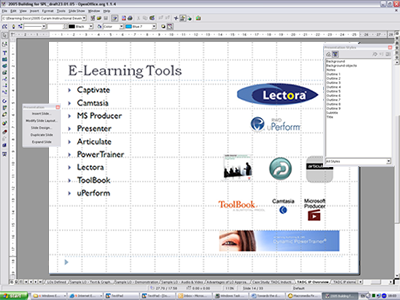
Figure 1. PPT format presentation authored in OpenOffice.org

The primary benefit of OpenOffice.org for this open environment is the ability to author XML-based content to develop presentations that may be used in instructor-led classroom environments, as well as provide media developers with a PowerPoint-formatted file to facilitate insertion into the media authoring tool Microsoft Producer 2.

In my view, the real power of OpenOffice.org is that it enables courseware developers to take (for example) PowerPoint presentations developed by SMEs, modify this content, and output it in an XML-based format, allowing integration with the other tools we are discussing in this series.

In a sense, it is a "bridge": despite the much-vaunted interoperability of Microsoft XML Core Services (MSXML) in Office 2007, I would assert that there are still many issues associated with integrating MS Office-produced content into an open environment, and by extension problems using this suite if you need to integrate your content into another environment or platform.

__________

References:

OpenOffice.org version 3.x. [Internet] Available from: http://www.openoffice.org [Accessed 24 August 2009]

--

Wednesday, October 7, 2009

Open Environment E-learning: DocBook and XXE

I received an unexpected but nonetheless very welcome comment on yesterday's blog post from Brent Schlenker. In his remarks, Brent reinforced my own view about the viability of open source-based e-learning development; he said that

I truly do believe that there are enough OpenSource tools out there that we can be creating completely opensource learning solutions/environments. Once people get past their initial fears and the stigma, the Open Source learning development community will grow exponentially.

...thanks for keeping the Open Source movement alive in eLearning.

Thanks Brent!

Now, on with the show.

As discussed in a previous post, we can say that there are certain unresolved philosophical matters surrounding the notion of open environments; I will return to these presently. However, the gratis/libre debate should not preclude you from taking advantage of the range of 'open' and 'free' tools to develop an effective e-learning solution.

As a reminder, here are the categories of tools I recommend to implement this open development environment:

  • Content Creation Tools
  • Media Creation and Integration: OSS Tools
  • Media Creation and Integration: Proprietary Tools
  • Content Delivery Platform
  • Optional Proprietary Tools

Click here for a full list of the applications and utilities.

While the tools themselves are a disparate group, their common characteristic is that they are XML-based. This, in theory at least, means that either the applications or their outputs are interoperable, and this creates the foundation for the "openness" that we seek.

Now read on...

Over the next few days, I will describe in detail the 'toolkit' used in this e-learning content development environment, before discussing pedagogical approaches and implementation processes. As the focus here is on developing e-learning in a specific environment, I am making the assumption that the learning content has already been developed, as learning content development and instructional design per se is not the topic being investigated. Click here to find out more about instructional design for e-learning.

The Powerhouse: DocBook and XXE

DocBook is a semantic markup language for technical documentation. While it was originally created for the purpose of writing technical documents for computer hardware and software, its inherent flexibility led to it being used authoring a broad range of documentation, including e-learning. Unlike proprietary word processors, DocBook documents do not describe what their contents "look like," but rather the meaning of those contents. For example, rather than explaining how an e-learning lesson page might be visually formatted, DocBook simply says that it is a page. An external processing tool or application is required to determine where the lesson page should go, and what it should look like – and to decide whether or not it should be included in the final output at all.

Because DocBook is XML-based, content can be authored and edited with any text editor.

XMLmind XML Editor (XXE) allows content creators to edit large, complex, modular, XML documents. In one sense, it is the friendly face of my open authoring environment. XXE is a ‘nearly’ WYSIWYG (What You See Is What You Get) editor that uses CSS to control the layout and style of DocBook XML (or XHTML) content. It successfully hides the complexities of XML markup from the author, so that the focus can be on the words, rather than the code.

In XXE, the document author does not see the DocBook XML tags; rather, XXE interprets the tags, and the application UI displays the content in the familiar look, feel, and style of a word processor interface (see Figure 1).

Figure 1 Screenshot of XMLmind XML Editor

Using XXE, the content author creates and edits content in the structured XML document by adding elements, setting attributes, selecting, cutting, pasting, and so on, and the editor automatically applies the appropriate styles.

The style is an interpretation of the DocBook DTD to simplify identification of the formatting elements without the need to understand all the XML tags.

Note, however that these styles are not linked to how the content is rendered. The final look and feel of the document is controlled by CSS style sheets.

XXE supports the following features:

  • Converts to XSLT-FO format then to PDF format
  • Converts to HTML format
  • Produces metadata files to support SCORM
  • Checks spelling
  • Checks that a document conforms to the DTD
  • Checks that a document conforms to relevant documentation conventions
  • Documents can be rendered as a number of separate files
  • Controls document look and feel

Transformations (outputting content to a commonly-used delivery format) are applied to the XXE-authored XML using Formatting Objects Processor. Formatting Objects Processor (FOP) is driven by XSL Formatting Objects (XSL-FO). A Java application reads a formatting object (FO) tree and renders the resulting pages to a specified output.

Currently supported output formats include:

  • Portable Document Format (PDF)
  • Printer Command Language (PCL)
  • PostScript (PS)
  • Scalable Vector Graphics (SVG)
  • eXtensible Markup Language XML (area tree representation)
  • Print
  • Abstract Window Toolkit (AWT)
  • MapInfo Interchange Format (MIF)
  • Text File (TXT)
The primary output target is PDF (see Figure 2).

Figure 2 Screenshot of PDF file generated from XXE via XSL-FO

Other outputs include HTML pages (see Figure 3) and help files.

Figure 3 Screenshot of HTML file generated from XXE via XSL-FO

These two outputs were generated from a command-line FO, because I’m a bit of a purist about this stuff, though I’m not a coder, so it must be straight-forward and usable!

Depending upon the level of expertise in your organization, you may decide to use a GUI shell to enable content authors to generate their outputs.

Figure 4 Screenshot of XSL-FO command line interface in Windows

More…

__________

Resources:

DocBook.org: http://www.docbook.org/

XMLMind XML Editor: http://www.xmlmind.com/xmleditor/

HyperWrite Ltd. (2006) Review of XMLmind XML Editor v3.0. [Internet] Available from: http://www.hyperwrite.com/Articles/showarticle.aspx?id=63 Retrieved 24th September 2009

--

Tuesday, October 6, 2009

A Toolkit to Develop E-Learning in an Open (XML) Environment

Returning from content development theory, the gratis/libre debate, and the pros and cons of each approach, this post will focus on the range Opensource.svg of tools that you need to develop e-learning content in a (relatively) open environment.

Now read on…

The key to developing e-learning courseware in an open environment is to use a production model that liberates instructional design and content authoring from your final media outputs. In my view, this means taking an XML-based approach to your e-learning development environment. I would suggest that you need tools and components like the following tools to create an effective authoring and delivering system:

Content Creation Tools

  • DocBook
  • XMLmind XML Editor (XXE)
  • GNU Image Manipulation Program (GIMP)
  • XSLT transformations and XS-FOP formatting object processors


Media Creation and Integration: OSS Tools

  • Audacity
  • CineFX
  • Kompozer
  • OpenOffice.org
  • GNU Image Manipulation Program (GIMP)

Media Creation and Integration: Free-to-use Proprietary Tools
  • Microsoft Producer 2
  • Windows Media Developer’s Kit
  • Garageband
  • iMovie
  • Jing

Content Delivery Platform
  • Apache / MySQL / PHP
  • Moodle
  • Joomla
  • Drupal

Optional Proprietary Tools
  • Adobe Flash
  • Camtasia
  • Roxio Easy Media Creator or Toast

I'll be discussing developing a production model using this toolkit, starting tomorrow.
--

Wednesday, September 17, 2008

Open source e-learning courseware development - Salasaga update

As I've discussed in the past, there's a whole constituency of e-learning courseware developers who, for either practical, philosophical, or even purely financial reasons have decided to create learningsalasaga_linux-0.8.0-alpha1 content using open source and free-to-use courseware.

One of the tools I looked at in the past is an open source Integrated Development Environment for producing e-learning called Salasaga. According to the author it will be

a free, easy to use GUI authoring environment that helps you create visually impressive and actually useful learning material. The short term goal for this project is to provide such an environment, and we're well on the way to a first release for doing that.
Initially similar to Adobe Captivate, but will eventually incorporate an AJAX (browser based) playback capability for advanced content. Flash has at least one serious design limitation (from [his] POV) making it nearly useless for comprehensive e-learning, and this appears to be addressed by the existing capabilities of AJAX in browsers these days.

Today, I just received an e-mail from Justin Clift, the developer behind the IDE. He updated me on the latest developments with the tool; primarily that it's in Alpha 4 version at the moment, and that going to included in Ubuntu Intrepid. He's excited.

In my view, any tool or utility that enables a wider range of people to access e-learning, whether as learners, or as in this case through leveraging the means of production can only help the future growth of e-learning as a means of educating the widest possible group of people.

--

Thursday, May 29, 2008

Salasaga: an Open Source E-Learning IDE

I recently authored a series of posts on developing e-learning content using an open source environment where I investigated the potential for creating and delivering e-learning using either free to use or freely available content authoring applications. In that series, I deliberately excluded mentioning tools to enable the capturing and post-producing demos and simulations, as the applications currently available that enable developers to create high-quality SWF-based content (such as Captivate and Articulate) come with a hefty price tag. However, that may be about to change.

Now read on.

For a while, I've been following the development path of an open source integrated development environment (IDE) called The Flame Project which

brings what Adobe Captivate offers to the Windows community, to Linux/*nix and others. The final aim is to provide functionality superior to Adobe Captivate, by enabling production of in-depth eLearning with properly verifiable results.
Flame has been renamed Salasaga, and the application is now available as and alpha release for Linux Ubuntu.


The developers' vision is

...imagine a free, easy to use GUI authoring environment that helps you create visually impressive and actually useful learning material. The short term goal for this project is to provide such an environment, and we're well on the way to a first release for doing that.

Initially similar to Adobe Captivate, but will eventually incorporate an AJAX (browser based) playback capability for advanced content. Flash has at least one serious design limitation (from my POV) making it nearly useless for comprehensive eLearning, and this appears to be addressed by the existing capabilities of AJAX in browsers these days.

As an alpha release, the IDE is not stable or functional enough to be used in a production environment, but in my view it shows great potential (particularly now that Adobe have opened up the runtime on Flash (as reported here), thereby freeing up developers to actually work with the code from the 'inside.'

Where Salasaga differs from tools like the popular Jing screen capture application, is that the former is available under the GNU LGPL, the latter is a free-to-use product created by TechSmith (of Camtasia fame). While Jing is a great little tool, it is, as the owners say "free for now" - similarly, the owners decline to state for how long the application will be publicly available. Finally, Jing content created by all its users is stored and delivered on TechSmith's ScreenCast streaming media hosting service, which locks content creators in to using TechSmith's solution end-to-end.

From an open source development perspective, this is not ideal.

The current system requirements to run Salasaga are:

Operating Systems

  • Linux
  • *BSD
  • Solaris Nevada
  • Windows XP - No development build presently available
  • Windows Vista - No development build presently available

Most recent distributions of Linux should work out of the box. Debian Testing on AMD64 has specifically been reported to work.

Please note that the *BSD, Solaris Nevada, and Windows testing only gets done around package creation time.

Requirements

  • Glib and GTK+ - version 2.10 or higher of both is known to work
  • Pango - version 1.16 or higher is known to work
  • libxml2 - version 2.6.30 or higher is known to work
  • Ming - version 0.3.0 or higher is known to work
Click here to view a short demo about installing Salasaga - presumably recorded and produced using the IDE.
--

Wednesday, May 21, 2008

Online Media Delivery Channels to benefit E-learning

In my last blog post I wrote about the optimism learning professionals are currently expressing about the short- to medium-term growth of the industry, despite the current economic climate, and the traditional impact that recessionary times have on learning and development in organizations. I've been thinking hard about the factors that may be influencing attitudes, but I'm not ready to put my thoughts to (electronic) paper just yet.

So today, I'm going to look at some developments that have the potential to positively affect e-learning content delivery.

Now read on...

I have talked on other occasions about using what Douglas Adams called PETs (Personal Electronic Things) to deliver e-learning content. On May 20th, British e-learning company Atlantic Link announced that they had developed an e-learning authoring solution for the Sony PlayStation Portable (PSP). According to their press release:

Atlantic Link's ...rapid e-learning authoring tools ... now allow courses to be designed specifically for the Sony PSP Slim & Lite. The courses can be deployed locally (from the Memory Stick Duo) or from the Internet, giving users a true mobile learning experience ... all the functionality of Atlantic Link’s rapid e-learning authoring tools can be applied to small screen format.


[Click image to view demo]

Atlantic Link MD Mike Alcock states:

The potential applications for this technology are huge ... [t]ourist guides, language training, product training and updates, maintenance guides and training, medical training, interactive museum guides, schools training, the list is almost endless.

Based on the information available from Atlantic Link's website, I can't tell whether the organization have developed a new set of templates for their current Rapid e-Learning authoring tools, or have created a new authoring platform specifically for PSP /Lite content development.

Given the range of potential applications for their content development system, Atlantic Link may have opened up a niche market for themselves by repurposing e-learning content authoring tools to deliver informational material in predominantly non-networked environments (see Mr. Alcock's quote above).

Is this innovative or new?

No.

Flash Lite has been around since 2004; what Atlantic Link seem to have done is created a point solution by simplifying the authoring environment (much like Captivate and Articulate do) to enable output on the PSP device. Similarly, I can't discern from the press release or website whether this content supports learning tracking, SCORM / AICC specifications and learners' formative and summative test results can be sent to and stored on an LMS.

It also may be the case that this type of approach has just been overtaken by events.

As well as announcing the latest version of their enterprise collaboration solution Adobe Connect Pro 7 (I'll review it once we get our sticky hands on it here in the office), Adobe have also announced the Open Screen Project, which they say is

dedicated to driving consistent rich Internet experiences across televisions, personal computers, mobile devices, and consumer electronics.

[by] taking advantage of Adobe Flash Player and, in the future, Adobe AIR -- that will remove barriers for developers and designers as they publish content and applications across desktops and consumer devices, including phones, mobile internet devices (MIDs), and set top boxes. The Open Screen Project will address potential technology fragmentation by allowing the runtime technology to be updated seamlessly over the air on mobile devices. The consistent runtime environment will provide optimal performance across a variety of operating systems and devices, and ultimately provide the best experience to consumers.

To support the Open Screen Project along, Adobe is:

  • Opening up the runtime to Flash Player so that anybody can develop a customized player. Specifically, it is going to open up the SWF and FLV/F4V specifications. In the past, developers had to sign agreements not to create derivative Flash players because Adobe wanted to avoid the fragmentation that Java experienced during its early years.
  • Removing licensing fees for Flash on mobile devices. While Flash is free on PCs, cell phone makers and other device manufacturers must pay a royalty fee. Instances of Flash are on 500 million mobile devices already (expected to grow to one billion over the next 12 months). As of the next major release of Flash (and AIR) for devices in 2009, it will be free to device manufacturers.
  • Publishing the APIs for porting Flash to other devices. This currently also incurs a royalty fee. Now, every device should come with a pre-installed Flash API.
  • Publishing Adobe protocols for pushing content to devices like Flash Cast and AMF. Adobe will also work with wireless carriers on protocols for over-the-air software updating.

I would suggest that the primary implication for learning professionals is that this could be the basis for a common (if not open) platform to enable learning materials to be delivered via multiple channels. With the support of a range of hardware manufacturers, there seems to be little threat of vendor lock-in; maybe manufacturers have finally understood that wider customer access has the potential to generate higher revenues than forcing people to use proprietary communications solutions?

in any case, being able to create content for a ubiquitous, device-independent platform will make my life less complicated and I suspect the same goes for a lot of other people too.

FOGRA: I was meant to be presenting at this year's ILTA EDTech 2008 Conference on 'non-formal workplace learning', but had to cancel due travel commitments: best of luck to all attending and presenting - I'll be keeping up with activities on the ILTA website.

--

Friday, May 16, 2008

End-to-end Development Process: E-Learning Course Development in an Open Environment: Project Lifecycle 8

Having discussed in some detail individual elements of the content development process, in this post we’re going to see how all the pieces come together in the Open Environment for E-Learning.

Figure 1. Inputs and Outputs
[Click to enlarge]

Here’s the end-to-end development process (see Figure 1):
1. Content authors agreed course structure according to the structure outlined in the instructional design
2. XML text data authored with XXE and the DocBook DTD
3. Images created and in GIMP and imported in to XXE
4. Course developed in XXE
5. Content reviewed and signed off
6. Content stored on Apache/MySQL/PHP-based content management system (CMS)
7. Narration script text generated from signed off content
8. Using Audacity, voice-over narration for multimedia presentation is recorded
9. Voice-over narration is post-produced in Audacity, reviewed and signed off


Final integration
1. Content accessed from CMS
2. XML data imported into OpenOffice.org Impress and exported as PPT-formatted file
3. Audio retrieved from database
4. Separately recorded video content retrieved from database
5. Content integrated in Microsoft Producer 2
6. Content rendered to final compiled format for delivery via multiple channels (see Figure 2)

Figure 2. Overview of Integration Process
[Click to enlarge]

7. Content exported to open source LMS/LCMS such as Moodle, or burned to DVD for delivery to customers (see Figure 3)

Figure 3. Final Course Structure
[Click to enlarge]

--

Thursday, May 15, 2008

Introduction to Repurposing Content. E-Learning Course Development in an Open Environment: Project Lifecycle 7

Modifying previously-produced content using for use in an Open E-Learning Environment

A topic I’ve touched on briefly in the past is that of repurposing content already developed in a different format. In my view, one of the more common (and unsatisfactory) processes used to develop courseware is to use Microsoft PowerPoint as the primary courseware authoring application. While the reasoning behind this is practical – for example, instructors delivering training in a classroom environment typically use PowerPoint as their presentation tool of choice, particularly in the corporate environment. Similarly, courses authored in PowerPoint can also end up being used as the basis for hard-copy document generation.

A typical process includes:

  1. Content (i.e. a series of lessons) authored in PowerPoint
  2. Lesson text extracted from PowerPoint imported into Microsoft Word. The content text is reformatted to enhance usability in hardcopy form (i.e. slide header made bold, 14 point etc)
  3. Slide images and text exported as WMF format images from PowerPoint and stored in a graphic assets folder for integration into the Word document version of the courseware.
  4. Because of file size issues, WMF images batch converted to high-quality GIF format.
  5. Images reinserted in Word document with adjoining text.
  6. Typically 10 to 12 lessons then inserted into a Word template and saved.
  7. Saved documents exported as PDF file in Adobe Acrobat Pro.

There are a number of significant inadequacies in this process, not least among them being:

  • complicated editing
  • difficulty revising materials
  • lack of traceability
  • versioning issues
  • discoverability of keywords and terms in either the source Microsoft Office application files or the compiled PDF document
  • severely restricted interoperability of content
  • restricted ability to deliver content using multiple channels (i.e. efficiently over the web)
  • use of proprietary formats to create content

Proprietary tools do not “play well with others” (Meyerding, 2004). For example, the Microsoft Office productivity suite has a long history of file format changes and despite the much-vaunted interoperability of Microsoft XML Core Services (MSXML) in Office 2007, it can be said that there are still issues with integrating MS Office-produced content into an open environment, and by extension problems using this suite if you need to integrate your content into another environment or platform.

--

References:

Meyerding, H. (2004). XML and Content Reuse Systems for Instructional Design Part 2: Implementing Content Repositories & Selecting Tools Part 1 The eLearning Developers Journal 3(1) [Internet] Available from: http://www.elearningguild.com/articles/abstracts/index.cfm?
action=view&CFID=822922&CFTOKEN=16828758
(Subscription required) Accessed 22nd October 2006

--

Wednesday, May 14, 2008

Course Structure. E-Learning Course Development in an Open Environment: Project Lifecycle 6

Operationalizing a Shareable Content Object-based (SCO) instructional design:

Based upon the the instructional model discussed in previous posts, I recommend designing a course to the following parameters (see Figure 1):

  • Section: a sequence of 5±2 Lessons related by core Learning Objectives
  • Lesson: a sequence of 5±2 Learning Objects
  • (Reusable) Learning Object (LO): a learning objective comprising a series of Learning Points; unit of assessment that measures the objective.
  • Learning Point/Reusable Information Object: a unit of instruction that teaches a key element of a learning object.
  • Knowledge Object (KO): a discrete piece of instruction or information represented textually, graphically, aurally, visually, by using animation. Combines with other KOs to create a Learning Point.

Figure 1. Course Structure
[click to enlarge]


Within the course, lessons are aggregated to the following order of granularity in the lesson structure (see Figure 2):
  • Each Lesson has 5±2 Learning Objects
  • Each LO has 5±2 Learning Points (aka RIOs)
  • Each LP contains a number of relevant Knowledge Objects
  • KOs/LPs are developed using appropriate media types


Figure 2. Lesson Structure
[click to enlarge]


Tomorrow: Modifying content created for different delivery channels for inclusion in an open e-learning environment

--

Tuesday, May 13, 2008

Outlining the Course Specification. E-Learning Course Development in an Open Environment: Project Lifecycle 5

Courseware Content Specification

After yesterday's discussion of a learning object-based approach, we can begin to develop a specification for on Open Environment e-learning course. At a high level, the specification for such a course could include:

  • Content to be based upon previously-agreed curriculum of content
  • The content be developed according to a Reusable Learning Object approach
  • Short development cycle -– three weeks proposed

Content Format
The content would be delivered in adherence to the following criteria:

  • A multimedia mix of audio, video, graphics, on-screen text.
  • Content to be stored and delivered on a Learning Management System. Content to be delivered via Flash-based a streaming media solution.
  • Content may also be delivered via download.
  • A DVD-based modular self-paced learning solution also be made available for learners with bandwidth issues.
  • Supplementary learning resources: starter kits, exercises, workshops, “how to’s”, case studies, email links to instructors, Web links to relevant resources associated with the courseware.

--

Monday, May 12, 2008

Defining Learning Objects. E-Learning Course Development in an Open Environment: Project Lifecycle 4

In reaching a satisfactory definition of learning objects, a search through the literature revealed three broad characterisations:

The main idea of 'learning objects' is to break educational content down into small chunks that can be reused in various learning environments, in the spirit of object-oriented programming.

(Wiley 2000)

[A]ny entity, digital or non-digital, that may be used for training, education or technology supported learning.

(LTSC 2002)

…modular digital resources, uniquely identified and metatagged, that can be used to support learning.

(NLII 2002)

From these descriptions, we can develop a working definition of a learning object:

A Learning Object is any digital resource that can be reused to support learning.

This definition contains the following attributes:

  • Learning objects are digital – can be stored and delivered electronically
  • Learning objects are a resource – they contain the total means available to deliver training and learning objects are reusable – a single learning object may be used in multiple contexts for multiple purposes.
  • Learning objects must contribute to the transfer of knowledge.

Further characteristics of learning objects include that they are self-contained – each learning object can be taken independently, they can be aggregated – learning objects can be grouped into larger collections of content, including traditional course structures, that they are interoperable - that learning objects have the ability to exchange information and to use the information that has been exchanged (usually through a specification like AICC or SCORM), and finally that they are tagged with metadata – every learning object has descriptive information allowing it to be easily found by a search.

References:


Wiley, D.A. (2000). Connecting learning objects to instructional design theory: A definition, a metaphor, and a taxonomy. In D. A. Wiley (Ed.), The Instructional Use of Learning Objects: Online Version. [Internet] Available from: http://reusability.org/read/chapters/wiley.doc Accessed 17 April 2008

McGreal, R. (2002). Learning Objects: a Practical Definition International Journal of Instructional Technology and Distance learning [Internet] Available from: http://itdl.org/Journal/Sep_04/article02.htm Accessed 16 April 2008

Duval, E. (ed) (2002). IEEE 1484.12.1-2002, 15 July 2002, Draft Standard for Learning Object Metadata IEEE Learning Technology Standards Committee (LTSC) [Internet] Available from: http://ltsc.ieee.org/wg12/files/LOM_1484_12_1_v1_Final_Draft.pdf Accessed 16 April 2008

Friday, May 9, 2008

A theoretical approach to e-learning content delivery in an Open Environment. E-Learning Course Development: Project Lifecycle 3

Theoretical approach – content delivery

Today's post discusses an approach to the delivery of multimedia content in an open (or indeed any) e-learning environment.

As Richard Mayer observes:

Multimedia messages that are designed in light of how the human mind works are more likely to lead to meaningful learning that those that are not. A cognitive theory of multimedia learning assumes that the human information processing system includes dual channels for visual/pictorial and auditory/verbal processing, that each channel has limited capacity for processing, and that active learning entails carrying out a coordinated set of cognitive processes during learning.

(2003, p.41)

Mayer’s Cognitive Theory of Multimedia Learning is based on three basic assumptions:

  1. Dual Channel Assumption: Humans have separate information processing channels for visually- and auditorily represented material. Information processing occurs in three stages (see Figure 1).
    Information enters our information processing system via either the visual or auditory processing channel. This is the input stage. The information is then processed separately but concurrently in working memory. Working memory can be thought of as RAM, where relevant sounds and pictures are selected and organized. Eventually the information from both channels are integrated and connected to other information already held in long term memory.
  2. Limited Capacity Assumption: People are limited in the amount of information that can be processed by each channel at any given time.
    Learners participating in any presentation can only hold a few images and a few sounds in working memory at one time. Psychologists have researched this concept of cognitive load extensively: while allowing for individual variability, memory span tests have demonstrated that on average, working memory typically allows the processing of from 5 to 7 chunks of information at a given time. Because of this restricted cognitive processing capability, people continually make decisions about the allocation of sensory information processing based upon the available stimuli.
  3. Active Processing Assumption: People actively engage in cognitive processing to construct coherent mental representations of their experiences.
    Rather than being passive 'information collectors, people are constantly selecting, organising and integrating information with past knowledge. Active learning occurs when we apply cognitive processes to the incoming material. The result of this processing is the creation of a mental model of the information presented. The three processes that are essential for active learning are: selecting relevant material, organizing the selected material and then integrating that material into existing knowledge structures. These processes take place within our fairly limited working memory.

Figure 1 Cognitive Theory of Multimedia
[Click to enlarge image]

From these, Mayer extrapolates a cognitive theory of multimedia learning. Mayer’s theory asserts that in multimedia environments, learners are engaged in five cognitive processes:

  1. Selecting relevant words for processing in verbal working memory
  2. Selecting relevant images for processing in visual working memory
  3. Organising selected words into a verbal mental model
  4. Organising selected images into a visual mental model
  5. Integrating verbal and visual models and connecting them to prior knowledge

As such, I would assert that a substantial proportion of the the initial design stage of the instructional development process is devoted to ensuring that the Split-Attention Principle (Mayer, Moreno 1998) – that students learn better when the instructional material does not require them to split their attention between multiple sources of mutually referring information, the Modality Principle - students learn better when the verbal information is presented auditorily as narration rather than visually as on-screen text, both for concurrent and sequential presentations and the Redundancy Principle - students learn better from animation and narration than from animation, narration, and text if the visual information is presented simultaneously to the verbal information were adhered to.


Mayer, R.E. (2003). Multimedia Learning New York, Cambridge University Press.

Mayer, R.E. Moreno, R. (1998). A Cognitive Theory of Multimedia Learning: Implications for Design Principles University of California, Santa Barbara [Internet] Available from: http://www.unm.edu/~moreno/PDFS/chi.pdf Accessed 12th April 2008

--

Thursday, May 8, 2008

An Open Environment for E-Learning Course Development: Project Lifecycle 2

Phase One: Using a Constructivist Theoretical Approach

Bruner’s 1966 text Toward a Theory of Instruction described the key principles of constructivism (p.225):

Table 1 Principles of constructivism

Principle

Definition

Readiness

Instruction must be concerned with the experiences and contexts that make the student willing and able to learn

Spiral organisation

Structure.

The content must be structured so that it can be grasped by the learner.

Sequence.

Material must be presented in the most effective sequences.

Generation

“Going beyond the information given” - Instruction should be designed to facilitate extrapolation and or fill in the gaps


Extending from these basic constructivist principles as well as from the work of other key figures in the constructivist school, Driscoll (1994) outlines five conditions for learning (p.382-3). Very much like the multiple approaches and interpretations that exist in constructivism, a number of conditions must be met for the approach to be implemented. It is useful to elaborate briefly on these conditions, as they are relevant to the learning approach discussed in the rest of this part of the blog.
  1. Providing complex learning environments that incorporate authentic activity. Constructivists argue that learners should learn to solve the types of complex problem they will face in real life. Learning how to do this is difficult unless complex and authentic learning environments are available to the learners.
  2. Providing for social negotiation as an integral part of learning. Bruner (1986) explains that learning is a cultural interchange between group members. Collaboration creates an opportunity for learners to share their understandings with others and to have others do the same with them. This provides multiple perspectives to each learner, and this negotiation process between peers should lead to enhanced understanding.
  3. Support multiple perspectives and the use of multiple modes of representation. Because learning skills, behaviours and knowledge can be diverse and complex, constructivists believe that to achieve complete understanding the learner must examine the material from multiple perspectives. If they are not supported in this endeavour, the learner will achieve only a partial understanding of the material. Multiple modes of representation allow the learner to view the same content through different sensory modes.
  4. Nurture reflexivity. Duffy and Cunningham (1996) characterise reflexivity as “the ability of students to be aware of their own role in the knowledge construction process.” (p.172). It could also be described as the learner taking ownership of their own thinking and learning processes. Driscoll (1994) assets that reflexivity and by extension critical thinking are central attributes in the constructivist methodology, as it enables learners to understand how and why cognition creates meaning. This enables learners to attain goals such as reasoning, understanding multiple perspectives, and expressing and defending their own beliefs.
  5. The last condition Driscoll describes is to “emphasise student-centred instruction.” Bruner (1966) calls this “discovery learning”. By obtaining knowledge by themselves, learners select and transform information, construct knowledge, and make decisions in the context of a cognitive structure that provides meaning and organisation to experiences and allows the individual to “go beyond the information given”. Students are actively engaged in determining what and how they will study or gain understanding.

These principles and conditions position the constructivist approach to learning as an appropriate orientation for learning sans frontiers; using technologies like the Internet, websites and virtual learning environments, applying collaborative learning, problem-based learning and goal-based mechanisms, making Open Source Software and Course- and Content Management Systems accessible to learners, and using e-learning applications like online conferencing and collaboration tools could be the foundation for these multiple constructivist conditions for learning. (Duffy & Jonassen 1992, Driscoll 1994; Schank 1994)

These characteristics provide an appropriate framework for knowledge workers to learn (and for the learning intervention), given that their ongoing development is based in the context of already-established cognitive schemata (from the learners’ perspective), the knowledge and skills are applied to solve real-world problems, and their expertise (behaviours) are typically used in collaboration with their peers to enhance the performance of organisations.

___________________

References:

Bruner, J. S. (1966) Toward a Theory of Instruction. Cambridge, MA: Harvard University Press.

Bruner, J. S. (1986). Actual minds, possible worlds. Cambridge, Mass: Harvard University Press.

Driscoll, M. P. (1994). Psychology of learning for instruction. Boston, MA. Allyn & Bacon.

Duffy, T. M. & Cunningham, D. J. (1996) Constructivism: Implications for the design and delivery of instruction. IN: Jonassen D. H. (Ed) Handbook of Research for Educational Communications and Technology (pp.170- 198). New York: Simon & Shuster Macmillan.

Schank, R. (1994) Active Learning Through Multimedia, IEEE Multimedia, 1(1), pp.69-78.

Wednesday, May 7, 2008

An Open Environment for E-Learning Course Development: Project Lifecycle 1

Phase One: Requirements gathering - Developing the Instructional Design

In 1996, ISD guru David Merrill et alia asserted that there were indicators to demonstrate that educational instructional design (ISD) had gone awry:

Too much of the structure of educational technology is built upon the sand of relativism, rather than the rock of science. When winds of new paradigms blow and the sands of old paradigms shift; then the structure of educational technology slides toward the sea of constructo-babble.


It was not until the Wright brothers discovered the correct principles of aerodynamics that they could invent an airplane that would sustain powered flight; it is not until we discover the correct instructional strategies that we can invent instructional design procedures and tools that will promote student learning.

(Merrill, Drake, Lacy & Pratt)


The instructional design applied in this Open Environment is quite closely aligned to the model developed by Roderick Sims in his 1997 article Interactive learning as an "emerging" technology: A reassessment of interactive and instructional design strategies.

[N]o … consensus has been established for interactive learning materials. There appears to be no common set of standards for the learner-computer interface, the strategies for presentation of interactive material is variable and the influx of newer technologies (such as multimedia and web-based resources) have only added to the complexity of developing effective interactive learning materials.

(Sims, 1997)

In this context and to provide a degree of "failover", I recommend aligning the Analysis, Design, Development, Implementation and Evaluation (ADDIE) instructional framework (see Figure 1) and Aubrey’s Interactive Instructional Influence Development (I3D) model.

Figure 1. An ISD model featuring the ADDIE processes

The I3D model (see Figure 2) presents a pragmatic approach to the development of courseware, “incorporating elements… of instructional design and project management ” (Sims) through integrating the “...deliverables, techniques and skills of courseware development” (Burford & Cooper, 1997) to enhance the likelihood of developing effective interactive courseware.

Figure 2. Aubrey's I3D model

[Click image to enlarge]

Aubrey designated the four deliverables in the I3D model as:

  1. Proposal
  2. Prototype
  3. Produce
  4. Package

which broadly aligns with the development lifecycle advocated in the Open Environment for E-Learning approach.

More tomorrow.

______________

References:

Aubrey, J. (1992). The interactive instructional influence model. Paper presented as part of the requirements for completion of the Graduate Diploma in Computer Based Learning. University of Technology, Sydney.

Burford, S. Cooper, L. (2003). Online development using WebCT: A faculty managed process for quality. Australasian Journal of Educational Technology. 16(3) [Internet] Available from: http://www.ascilite.org.au/ajet/ajet16/burford.html Accessed 16 Apr 2008

Merrill, M.D. Drake, L. Lacy, M.J. Pratt, J. & ID2 Research Group Utah State University (1996). Reclaiming Instructional Design Instructional Design Resources [Internet] Available from: http://itech1.coe.uga.edu/itforum/extra2/extra2.html Accessed 16 April 2008

Morrison, D. (2003). E-learning Strategies How to get implementation right first time, Chichester: John Wiley & Sons, Ltd.

Sims, R.C.H. (1997). Interactive learning as an "emerging" technology: A reassessment of interactive and instructional design strategies. Australasian Journal of Educational Technology. 13(1) 68-84. [Internet] Available from: http://www.ascilite.org.au/ajet/ajet13/sims.html Accessed 16 Apr 2008

--

Tuesday, May 6, 2008

Open Environment E-learning 6: Microsoft Producer

Microsoft Producer for Microsoft Office PowerPoint 2003, the current version of this popular add-on for Microsoft PowerPoint, is a freely available application that facilitates the capture, synchronisation, and publishing of audio, video, slides, and images. The primary reasons for choosing this application for content integration were it’s low learning curve for non-media experts, as well as it’s facility to export SCORM metadata as part of the final output package.

Other features include the familiar Microsoft Office interface provided, as well as the ability to import Microsoft formats including Visio files, Windows Video and Windows Audio files, spreadsheets data etc., without major conversion issues. These file formats are output as common HTML, JPEG and GIF files during rendering, and appropriate structured metadata is generated to mark the content for inclusion in a database repository.

Some disadvantages of Microsoft Producer are that it will not “play well” with file formats like QuickTime .MOV files, Photoshop .PSD files or Adobe .PDF documents, which means that content needs to be rendered in a Microsoft-friendly format.

Microsoft Producer enables the content integrator, in a three-tabbed timeline-based interface, to finely-tune synchronisation of the slide, audio, and video elements of the presentation.

(Using Microsoft Producer: A Guide for Educators, pp. 6-7)


msprod2

Figure 1 Microsoft Producer 2 UI

Final rendering of content was normalised using bit-rate, hardware and software parameters optimised for output to DVD for playback on Windows-based PCs and laptops.


References:

Microsoft Corporation Inc. (2004) Using Microsoft Producer: A Guide for Educators [Internet] Available from: http://www.microsoft.com/education/edguideproducer.mspx Accessed 4 Apr 2008 pp6-7

--

Friday, May 2, 2008

Open Environment E-learning 5: Audacity Audio Editor

Having discussed a range of primary design and authoring tools, today's post will look at one of the key content development tools, an open source non-linear audio editor (NLE) called Audacity.

[It] is an easy-to-use audio recorder and editor for Windows, Mac OS X, GNU/Linux, and other operating systems .

(sourceforge.net)

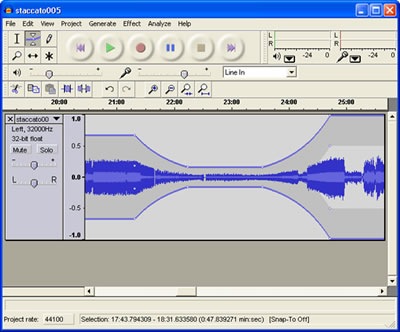
Audacity has the capability to record live sound, convert analogue media sources, and manipulate audio. Its functions include:

  • Export to digital recordings like podcasts or CDs
  • Edit WAV, MP3, FLAC, and Ogg Vorbis sound files
  • Cut, copy, splice, and mix multiple audio files
  • Apply a range of digital signal processes including normalization, noise reduction, EQ, and compression

audacity audio editor

Figure 1 Audacity audio NLE

Audacity enables audio content may be exported in a wide range of formats, making it an exceptionally flexible tool for content developers. With a relatively shallow learning curve, the application can be used by non-experts after a few hours on instruction and use, while retaining the features found in proprietary NLEs like Steinberg WaveLab and Sony Sound Forge for media developers .

This level of functionality enables both SME and specialist content developers to take advantage of the features in the application in an Open Environment for E-Learning.

References:


Audacity website About Audacity [Internet] Available from: http://audacity.sourceforge.net/about Accessed 1 May 2008

--

Thursday, May 1, 2008

Open Environment E-learning 4: Mind Mapping Tools

Designing the structure of a syllabus, curriculum, or course is one of the key activities to be undertaken well to ensure the course meets the learners' needs. A discussion about approaches to instructional design is beyond the remit of this series of posts on developing learning content in an Open Environment; I recommend Benjamin Bloom's Taxonomy of Educational Objectives as a good starting place to investigate this broad discipline.

Now read on...

Instructional designers use a range of tools to develop the instructional design (ISD) of e-learning courseware, everything from pen-and-paper to word processors to more specialized ISD tools like mind mapping applications: one of the most effective of this latter category is Freemind.

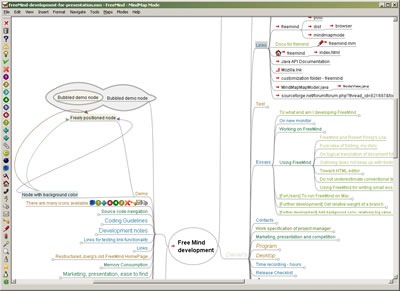
A mind map is a diagram used to represent words, ideas, tasks or other items linked to and arranged radially around a central key word or idea such as a learning objective. It is used to generate, visualize, structure and classify ideas, and as an aid in organizing content.

Mind map in Freemind

Figure 1 A mind map in the Freemind UI

FreeMind is an open source mind mapping application written in Java.

It supports the following features:

  • Folding of branches
  • Export to XML, HTML, XHTML (a static 'all-expanded image' plus expanding +/- list below image). Also exports an 'all-expanded image' in the following formats: PNG, JPEG, SVG and PDF format. Images are non-interactive. The current Beta version; v.0.9.0 Beta 8 supports export to Flash SWF).
  • Icons on nodes
  • Clouds around branches
  • Graphical links connecting nodes
  • Search restricted to single branches
  • Web and file hyperlinks from nodes

More tomorrow.

--

References:

Bloom B. S. (1956). Taxonomy of Educational Objectives, Handbook I: The Cognitive Domain. New York: David McKay Co Inc.

Links:

Freemind website on SourceForge.net [Internet] http://freemind.sourceforge.net/wiki/index.php/Main_Page (Accessed 30 April 2008)