Designing the structure of a syllabus, curriculum, or course is one of the key activities to be undertaken well to ensure the course meets the learners' needs. A discussion about approaches to instructional design is beyond the remit of this series of posts on developing learning content in an Open Environment; I recommend Benjamin Bloom's Taxonomy of Educational Objectives as a good starting place to investigate this broad discipline.
Now read on...
Instructional designers use a range of tools to develop the instructional design (ISD) of e-learning courseware, everything from pen-and-paper to word processors to more specialized ISD tools like mind mapping applications: one of the most effective of this latter category is Freemind.
A mind map is a diagram used to represent words, ideas, tasks or other items linked to and arranged radially around a central key word or idea such as a learning objective. It is used to generate, visualize, structure and classify ideas, and as an aid in organizing content.
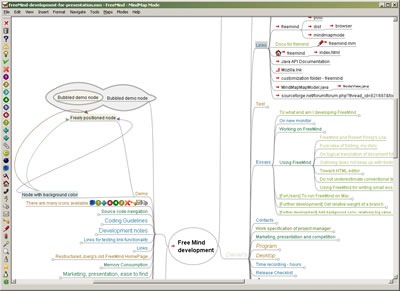
Figure 1 A mind map in the Freemind UI
FreeMind is an open source mind mapping application written in Java.
It supports the following features:
- Folding of branches
- Export to XML, HTML, XHTML (a static 'all-expanded image' plus expanding +/- list below image). Also exports an 'all-expanded image' in the following formats: PNG, JPEG, SVG and PDF format. Images are non-interactive. The current Beta version; v.0.9.0 Beta 8 supports export to Flash SWF).
- Icons on nodes
- Clouds around branches
- Graphical links connecting nodes
- Search restricted to single branches
- Web and file hyperlinks from nodes
More tomorrow.
--
References:
Bloom B. S. (1956). Taxonomy of Educational Objectives, Handbook I: The Cognitive Domain. New York: David McKay Co Inc.
Links:
Freemind website on SourceForge.net [Internet] http://freemind.sourceforge.net/wiki/index.php/Main_Page (Accessed 30 April 2008)







2 comments:
we are looking at http://www.mindmeister.com/ because it allows collaberation.
Thanks for your comment; I think that collaborative mindmapping tools such as the one you describe (Adobe Connect has a plug-in that enables the same level of functionality too, for example).
The rather 'purist' challenge I set myself in this series of posts is, as much as possible, to adhere to discussing open source applications rather than proprietary solutions.
Mindmeister is a fantastic tool, though; I would recommend it as long as you don't mind storing your stuff on someone else's server!
Post a Comment