Somebody once said:
Although e-learning began as a new way to deliver training, it cannot remain that way because it is no longer able to adequately support all the learning needs of individuals and organizations by itself - if it every was. E-learning has moved in a new, somewhat unanticipated direction that is not always reminiscent of an instructional framework. To be more influential, e-learning must be reinvented. While continuing to provide a viable instructional option in a formal learning setting, it must also move toward informational and collaborative solutions that focus more prominently on the specific jobs people do. It must move beyond courseware and classrooms and into work. To reinvent e-learning is, in many ways, to reinvent learning itself.
(Marc J. Rosenberg, Beyond E-learning)
In essence, this means transforming learning, so that learning activities and resources are situated around
- the learner
- their environment
- their tasks
enabling learners to construct their own knowledge in the context of what resources they need to carry out their activities effectively.
David Jonassen says:
In constructivist learning environments, technologies are used to situate learning tasks in a variety of contexts. With video, very rich and engaging contexts can be created.
He asserts that in the traditional organizational approach that
[u]nfortunately, most e-learning replicates the worst features of face-to-face instruction. So, it may be cheaper to "deliver" knowledge over the Internet, but it will not be more effective.
In the context of organizational development and workplace learning, this is commonly known as the systems-based approach to instructional design & development (ISD). A system is a set of elements or components that must integrate to perform a specific function. Every job in an organization is used by the organizational ecosystem to produce a product or output. The product or output is the means by which a organization generates its assets and remains self-supporting. In theory, this leads to the creation of a virtuous circle of continuous growth and development.
In learning and development, this systems-based approach is epitomized by the 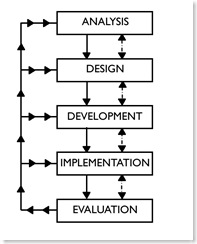 ADDIE conceptual framework, most notably refined by Dick & Carey in The Systematic Design of Instruction (1996).
The ADDIE approach has been one of the core tenets of instructional design for the best part of two decades.
I think ADDIE is a myth.
And I'm not alone in reaching this conclusion. In his article In Search of the Elusive ADDIE Model (2003), Michael Molenda undertook a Livingstonian attempt to discover the source for the original reference to the ADDIE model. Molenda’s research uncovered no original reference for the ADDIE model. This lack of an original reference led Molenda to write,
I am satisfied at this point to conclude that the ADDIE Model is merely a colloquial term used to describe a systematic approach to instructional development, virtually synonymous with instructional systems development (ISD). The label seems not to have a single author, but rather to have evolved informally through oral tradition. There is no original, fully elaborated model, just an umbrella term that refers to a family of models that share a common underlying structure.
(p.1)
My view is that ADDIE emerged from the principles of project management, and resemble the philosophy and practice to this discipline's methodology more than a pedagogy. Treating learning like a project leads to "training outcomes" equivalent to project deliverables.
While these training deliverables may have value in and of themselves, they have limited value for learners in the longer term. We could even say that the training outputs are valid; some of the objectives of the learning intervention designed according to the precepts of ADDIE may be met but
Our field of educational communications is founded on the premise that communicating content to students will result in learning. In educational communications, information or intelligence (in many different forms) is encoded visually or verbally in the symbols systems employed by each technology. During the "instructional" process, learners perceive the messages encoded in the medium and sometimes "interact" with the technology. Interaction is normally operationalized in terms of student input to the technology, which triggers some form of answer judging and response from the technology in the form of some previously encoded (canned) message. Technologies as conveyors of information have been used for centuries to "teach" students by presenting prescribed information to them which they are obligated to "learn."
(Jonassen, 2001)
So, can we re-invent e-learning?
___________________
References:
Dick, W. & Carey, L. (1996). The Systematic Design of Instruction (4th Ed.). New York: Harper Collins College Publishers.
Exclusive Interview with Professor David Jonassen (2001) IN: elearningpost [Internet] Available from: http://www.elearningpost.com/articles/archives/
exclusive_interview_with_professor_david_jonassen [Accessed 12th January 2007]
Molenda, M. (2003). In Search of the Elusive ADDIE Model. [Internet] Available from: http://www.indiana.edu/~molpage/
In%20Search%20of%20Elusive%20ADDIE.pdf Accessed 12 May 2008
Rosenberg, M.J. (2001) What Lies Beyond E-Learning? learningcircuits.org e-zine [Internet] Available from: http://www.learningcircuits.org/2006/March/rosenberg.htm Accessed 14th April 2007