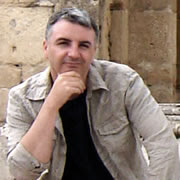
There's an American-Irish comedian (yes that's correct - a Bronx native who's emigrated to Ireland) called Des Bishop who decided to learn to speak the Irish language. More about his encounter with learning Irish and the context for e-learning and language teaching later.
Now read on.
For non-Irish people - apparently there are approximately two people in the world who don't claim Irish roots - here's some context:
Modern Irish is very different from the other languages discussed ... in that it is not a language which suffers from poor support: questions on the Irish census about Irish language universally show a strong positive reaction to the revival movement. Nor does the language lack official status; it is, according to the constitution of the Republic of Ireland, the “first language” of the country. There is also widespread political and economic support for the revival effort. The numbers of its speakers is not as low as the number of speakers of many languages; the official estimate of native Irish speakers hovers around the 80,000 mark. It also cannot be said of Irish that there has been a lack of a revival effort. The Irish language revival movement dates back to the beginning of the home-rule movement in the middle of the last century. Finally, it is not a language that is lacking in linguistic description or dictionaries. It is, however, a language which is perhaps at the most critical stage in its history and may very well not survive more than another generation or two.(Modern Irish: A Case Study in Language Revival Failure, p.1)
The most well-known Irish Revival movement began when Irish writers such as Lady Gregory, Percy French, George Russell ("Æ"), Oliver St John Gogarty, Padraic Colum, Edward Martyn, Edward Plunkett and William Butler Yeats stimulated a new appreciation of traditional Irish literature and Irish poetry in the late 19th and early 20th century. For a wide range of (mainly socio-political) reasons, in the mid- to late 20th century, the Irish language was firmly shackled within the constraints and agenda of "Official Ireland" - the structures of government and state, the philosphy of Irish Nationalism, the aspirations of the constitution, and so on.
All the while, the citizens of Ireland went about their English-speaking ways, probably like myself with a vague and romantic affection for the notion of Irish. As a nation we knew full well that to thrive in North America, the UK, and Australia, where Irish emigrants traditionally settled, we needed to focus our not inconsiderable linguistic skills (Ireland's total population is about the same as the city of Los Angeles in the US or Birmingham in the UK; there have been four Irish Nobel Prize for Literature laureates - an extraordinarily high figure of awards per capita) on the English language. So, how do you fail to teach a native tongue to a linguistically sophisticated, geographically isolated, culturally homogeneous, and relatively small populace?
Perhaps the highest blame that can be assigned for the failure of the language and its revival can be firmly placed with the language revivalists themselves. Despite obvious good intentions, some remarkably bad policy decisions have been made. Probably the biggest problem for the revival movement has been in putting the burden on the educational system, rather than in promoting the usefulness of the language in everyday life. Children were expected to learn Irish in school, and this was supposed to revive the language. Not only did this create widespread resentment towards the language, it is a remarkably naïve view of language learning, as first noted by Slomanson (1994). It equates language learning to the learning of math or geography or history. As linguists, we know that this is simply not the case. Language is not a “subject” that can be taught formally in an hour a day. Rather, language learning is a subconscious cognitive system that requires maturation and constant and consistent input. We as linguists know, but the revivalists in Ireland did not, that language is acquired, rather than learned. This naïveté with respect to what constitutes how we acquire language was compounded over and over again by the systematically poor pedagogical methods and materials that were used to “teach” the language. Lessons in Irish consisted, until quite recently, of translation exercises and reading of texts. Little or no work was put into conversation language practice and use. It is no wonder, then, that the emphasis on schooling in the language was an abject failure.(p.17)
Which brings us back to Des Bishop. As an US-born person who moved to Ireland aged 14 years, Des was "exempt" from taking compulsory Irish in school, but decided in his early 30's to learn the language. He brings what anthropologists call an etic perspective to the culture and the process of attempting to educate individuals in Irish. His experiences (documented in a series called In the Name of the Fada* on Irish state broadcaster RTÉ) reinforce the failure that formal educational approaches have had in learning the language, and how he succeeded in learning Irish experientially; “the process whereby knowledge is created through the transformation of experience” (Kolb, 1984, p.41).
And now here's the e-learning angle: as a recent learner of the language, Des advocates the use of e-learning as a medium to develop language skills: you can try your hand at the course Abhair Leat by clicking on this link or the image below.

Now, I have to confess that I haven't had an opportunity to evaluate the courseware yet - I'll submit a future post on the topic when I have had the chance to check it out properly.
I believe that the Irish experience points to a a much larger development in language learning. Look at the great migrations of the late 20th and early 21st centuries, particularly the number of native Spanish speakers in the US, as well as the likely linguistic impact of migration within the European Union (there are over one million Poles now living in the UK, for example).
Consider the role language plays in bilingual states like Canada and Belgium, and polyglot nations like China and India. As this century progresses, possibly the only way that large numbers of people will successfully acquire the language skills needed to function in a globalized economy will be through e-learning, and in this light, the experience of Irish is a lesson that should be well learnt.
Beannachtai Na Féile Pádraig.
Footnotes:
The acute accent, or síneadh fada (´), serves to lengthen the sound of the vowels and in some cases also changes their quality.
References:
Carnie, A. (1996) Modern Irish: A Case Study in Language Revival Failure [Internet] Available from: http://dingo.sbs.arizona.edu/~carnie/publications/PDF/Endangered.pdf [Accessed 15 March 2008]
Kolb, D. A. (1984) Experiential Learning. Englewood Cliffs, NJ. Prentice Hall
--